Showing posts with label Interviewing. Show all posts

Monday, March 4, 2013

SFSYO: Scientist of the Month Michael Dickey

Science For Six-Year-Olds (SFSYO for this school year) is a recurring segment on Science Decoded for Mrs. Podolak's first grade class at Lincoln-Hubbard elementary school. This year the posts are inspired by #iamscience (also a Tumblr) and #realwomenofscience two hashtags on twitter that drove home for me the importance of teaching people who scientists are and what they really do.

Hello first graders! I'm so excited to introduce you to our March scientist of the month Dr. Michael Dickey. Michael is a chemical engineer at North Carolina State University. Like I did with our other scientists, PennyPhilippAnne-Marike, Pete and Becky, I asked Michael some questions to find out more about what he does. I hope you will enjoy learning more about him and his job. Below you can read our interview, and if you'd like to ask him any questions, be sure to leave them in the comments!

Erin: What kind of scientist are you?

Michael: I'm a chemical engineer. To understand the importance of chemical engineers, just consider your day-to-day life or look around you. The electronics you play with, the paper your books are written on, the paint on your walls, the plastics and fabrics in your car, much of the food you eat....these are all made or improved upon by chemical engineers. In general, chemical engineers take materials and substances and turn them into things that are valuable. In the past, a common example might be digging oil out of the ground and then separating and processing the chemicals in the oil to turn them into things like gasoline, fuel, chemicals, and plastics. These days, chemical engineering is much more diverse and chemical engineers work on many different problems from biology, the environment, clean energy, and nanotechnology, just to give a few examples.
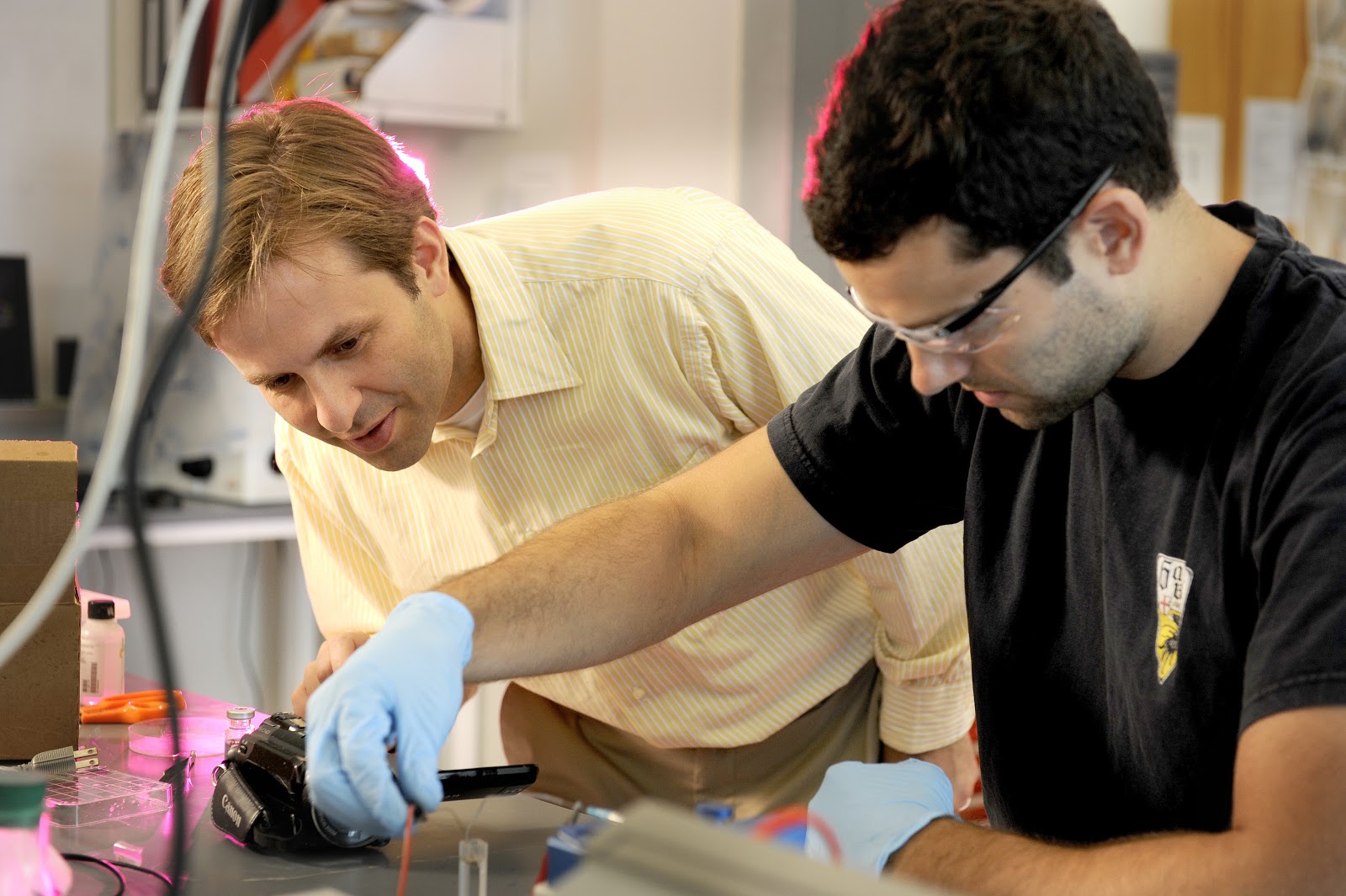
Photo courtesy of Michael Dickey.
Erin: Where did you go to school, and what did you study?

Michael: I grew up in North Carolina and went to school there until college. I went to Georgia Tech for undergraduate, Texas for graduate school, and did a post-doc at Harvard. All of my degrees are in chemical engineering.

Erin: Where do you work, and what does a typical day at work entail?

Michael: I work at North Carolina State University as a professor. The job is fun, but incredibly demanding.  I usually tell people it is like doing 2-3 jobs at a time. Teaching is a part of my job, but the thing that takes the most time is running a research group and mentoring students. The job involves raising money to support the students and to buy equipment and supplies, managing the research money, and mentoring students. I don't often get to work in the lab, but I enjoy talking about science with my graduate students. A typical day for me involves a lot of meetings with colleagues and students. I also spend a lot of time on my computer replying to emails, reading, and writing.


  Erin: Why did you decide to become a scientist?

Michael: I always liked math and science, it it was something I wanted to do for a long time. It probably became more clear to me in high school that those were my best subjects in school.


Photo courtesy of Michael Dickey
Erin: What is your favorite thing about your job?

Michael: I like the freedom of the job, the fact every day is different, the intellectual satisfaction, and the ability to work with (and help) young people.

Erin: What is something about your job that would surprise us?

Michael: There is a misconception about professors. Most people think it is an easy job, but most of my colleagues work all of the time because the job is so demanding. I "only" teach one class each semester, but the teaching represents a very small portion of my job responsibilities.

Erin: What are some of the things you like to do for fun?

Michael: I have two daughters that are two and four years old. They are so much fun to play with.  I also love going to basketball and football games. I enjoy playing guitar and exercising, although it is often hard to find time to do either these days.  I also like movies and reading, but again, I don't have much time these days to do those things!


What do you think first graders? I think it is pretty interesting that a lot of scientists are also professors, and work at universities or colleges like Michael does. Do you have any questions for him about being a chemical engineer and a professor? Let him know in the comments.

For more information check out these awesome videos showcasing some of the research from Michael's lab:
Self-Healing Stretchable Wires
Ultra Stretchable Wires
3-D Objects, Just Add Light

Thank you Michael for being our March Scientist of the Month!

Friday, February 8, 2013

Blogging 101 Here's What I Know

Not that I expect anyone to want to take the 20 minutes to watch a video that is essentially just me talking, but I recorded this interview about tips for bloggers who are just starting out so I thought I'd share it here. This was done as a prelude to a guest lecture that I gave in a Life Science Communication class at the University of Wisconsin-Madison. The students asked some great questions, that I figured were also worth answering here on the blog. If you have questions about getting started as a blogger or want to add some wisdom (please, do!) definitely let me know in the comments.


Questions from the class:

Has your strategy for promoting and writing the blog changed since getting a full-time job?
Absolutely, I have less time to maintain the blog than I did when I was in school, so I have to be more strategic about what I do. I'm down to writing one post a week and I spend a lot more time on Twitter. 

How do you find and pick which topics to write about?
For a more detailed answer about this one, you can check out Filling the Empty Page: Reading to Write where I talk more about how I get story ideas from the things that I read, and how important it is to write about what genuinely interests you. 

If there is one thing you could have done differently what would it be?
I would have (and still should) comment more on other blog posts. This is a case of not practicing what I preach, I'm well aware of the benefits of commenting and getting involved in other forums, I just don't do it nearly as often as I should. 

Is there a certain way you suggest commenting? As in: ask questions, critique, converse, praise, etc.
Comment however you want to, just make sure you are saying something that contributes to the conversation in some way.

How do you make yourself seem credible when writing about a serious matter?
If you check your facts, use the right sources, and are thoughtful and dedicated to getting the post correct then you are credible. People will see that. 

Are you using other social media sites besides Twitter to grow your blogging audience?
I just started using Google+ more, I'm intrigued to see what comes of it. 

Any advice in finding your blogging voice?
Blog a lot. When I first started Science Decoded, I wrote a lot more than I do now. You need to try it out, try different kinds of posts, explore different topics and eventually you'll figure out what feels right to you. Give yourself time to develop your voice, you aren't going to have everything exactly how you want it right out of the gate. 

Any tips for reaching out to influential stakeholders, it seems intimidating.
If tweeting or commenting to someone well established in your field, I think the best advice I can give is to just go for it - but have something of substance to say. If it really makes you uncomfortable, practice interacting with people you consider your peers first to get a better sense for how it all works. 

After you established a professional blog did you ever find yourself posting off topic of your specific aim because it was just so interesting you had to share it?
Absolutely. I kept Science Decoded fairly open ended in the first place because I knew I wanted the ability to write blog posts about a variety of topics. Even so, I've written posts that haven't been related to science like when I went on a rant about supporting philanthropic causes or explained my fascination with Amelia Earhart. In my opinion, you can go off topic once in a while and you shouldn't have a problem.

How do you keep your ideas confined to a tweet?
Tweeting short hand is tricky, it takes practice to instinctively distill ideas into a tweet but you'll get the hang of it. 

What aspect of your writing has improved most over the years? (being concise, structure, etc.)
I would say the thing about my writing that has improved most since I started blogging is the ease with which I write in my own style. Like I said in answer to another question, your voice develops and becoming comfortable with my own voice is I think the best take-away from blogging. 

If you have any tips of your own, or if you have any other questions you'd like me to try to answer leave it in the comments! 

Monday, November 5, 2012

SFSYO Scientist of the Month: Philipp Schiffer

Science For Six-Year-Olds (SFSYO for this school year) is a recurring segment on Science Decoded for Mrs. Podolak's first grade class at Lincoln-Hubbard elementary school. This year the posts are inspired by #iamscience (also a Tumblr) and #realwomenofscience two hashtags on twitter that drove home for me the importance of teaching people who scientists are and what they really do.

Hello first graders! I hope you are all okay and back at school after hurricane Sandy. Now that it is November we have a new scientist of the month. I am so excited to introduce you to Philipp Schiffer who is finishing up his PhD at school in Cologne, Germany. Like I did with Dr. Penny, I asked Philipp a bunch of questions to find out more about what he does. I hope you will enjoy learning more about him. Below you can read my interview with Philipp, and if you'd like to ask him any questions, be sure to leave them in the comments!
***
At work in the lab. Courtesy of Philipp Schiffer.
Erin: What type of scientist are you?

Philipp: I'm an evolutionary biologist [this means he studies genetics, DNA, and how different living things came to be,] currently I've morphed into a computer geek but I'm hoping to move away from the computer screen a bit more in the future. 

Erin: What did you study in school, and where did you go?

Philipp: I studied Biology, majoring in Zoology with minors in Genetics and Palaeontology. I did most of my studies at the University of Cologne, Germany with some time in Australia studying and catching wombats.  I'm currently finishing my PhD thesis in Cologne, but I've also studied at the University of California Riverside where I was learning about nematodes. I also got to spend some time in Edinburgh in Scotland. 

Erin: Where do you work and what does a typical day at work entail?

Philipp: It's called the Cologne Biocenter, in the middle of Köln am Rhein. At the moment I am spending most of my working hours in front of my computer, doing science in-silico, which means I am analyzing data from the genome sequencing assays I conduct. In between I hop over to the lab to study the nematodes, look at their DNA or run some other experiments. 

Erin: Why did you decided to become a scientist?

Philipp: I have always liked to think about things. I guess when I was in the 9th or 10th grade I wanted to tackle the big problems/questions like finding a cure for diseases. Now of course, I do something totally different, which I actually like better!

Out of the lab! Courtesy of Philipp Schiffer.
Erin: What is your favorite thing about your job?

Philipp: There is a new and intriguing question to answer every day, more than one on most days. That is the main thing, I am really interested in answering questions about life - why it is the way it is and how did it become like that? Why are species different and how does it happen. There is a woo hoo! moment when things finally click into place and make sense, which is really cool. It is also really nice to work with people around the world - I like the exchange of thoughts and ideas in different cultures. I enjoy talking to colleagues very much, and working with students. It is also fun to be able to listen to music when working, and so much more. 

Erin: What is something about your job that might surprise us?

Philipp: There is no magic in science, actually most ideas or experiments don't work the way you think they will, and once something really works the main thing is to wonder why did it work this time? So there is a lot of frustration in being a scientist, but then there is also a lot of fun. Still, the first thing is the most important, science is hard work. 

Erin: What are your favorite things to do for fun?

Philipp: Science IS fun. I also like wind surfing and sailing, I like rugby too and wish I had more time to do that. I also read about history, politics, and the world in general as much as I can. I very much enjoy chatting with friends over coffee.
***

What do you think first graders? I think Philipp has a pretty cool job, and he's gotten to go to school in so many different places, can you find them all on a map? If there is anything you'd like to know about his research, make sure to ask him questions in the comments. 

For any of my regular (adult) followers you can catch Philipp on Twitter @evolgenomology. If you'd like to be featured as a scientist of the month send me an email or DM me on twitter, I'd love more volunteers and thank you Philipp for lending us your time to share what you do!

Tuesday, October 2, 2012

SFSYO Scientist of the Month: Penny Higgins

Science For Six-Year-Olds (SFSYO for this school year) is a recurring segment on Science Decoded for Mrs. Podolak's first grade class at Lincoln-Hubbard elementary school. This year the posts are inspired by #iamscience (also a Tumblr) and#realwomenofscience two hashtags on twitter that drove home for me the importance of teaching people who scientists are and what they really do.


Penny in the Canadian High Arctic
Summer 2012. Courtesy of Penny Higgins.
Hello first graders! I am so excited to share with you our first scientist of the month, Penny Higgins, PhD. I asked Penny a bunch of questions to find out more about what she does. I hope you will enjoy learning more about her. Below you can read my interview with Penny, and if you'd like to ask her any questions, be sure to leave them in the comments! 
***
Erin: What type of scientist are you?

Penny: I am a vertebrate paleontologist, which means I study fossil animals that have bones (fish, amphibians, reptiles, birds, and mammals. Dinosaurs in are in this category too.) I am also a geochemist, which means I study the chemistry of geological things like rocks. These are related because bones and teeth are made of a mineral (called apatite). I study the chemistry of fossil teeth and bones to learn about what extinct animals ate and what the environment was like (how warm was it? how much did it rain?) when they were alive.

Erin: What did you study in school, and where did you go?

Penny: I studied both geology and biology in school, since fossils come out of rocks (geology) and represent animals that were once alive (biology). I also took a lot of chemistry classes. I ultimately got a PhD in Geology. I went to school in Colorado for five years, then went for another five years in Wyoming, where I got my PhD. Then I studied another four years after that in Florida. Now I live in Rochester, NY.

Erin: Where do you work?

Penny: I work at the University of Rochester, in Rochester, New York. My main job is to manage a laboratory where we measure the chemical properties of rocks and minerals. We also analyze things like hair, bugs, and flowers. I also teach beginning geology and a couple of paleontology classes. During the summer, I travel all over to collect fossils (and rocks) for my research.

Erin: What do you do on a typical day?

Penny: Most days during the school year, the first thing I do in the morning is start a set of analyses on our mass spectrometer. Then I go and teach classes, work with students on their research projects, and make sure that everyone is getting good data. When things are quiet I do my own research.

Erin: Why did you become a scientist?

Penny: I loved science from the moment I knew what it was. I was hooked by Carl Sagan’s Cosmos videos [Cosmos is an old TV series, you first graders wouldn't know it but maybe your parents will!] I also enjoyed drawing animals, especially horses, and started to study their anatomy and the shapes of their bones. Once I realized I liked bones, I wanted to draw dinosaurs and started to study them so I could draw better pictures. That’s why I became a paleontologist. What’s funny is that, now that I really am a paleontologist, I’ve never done anything with dinosaurs, but I have looked at fossil horses!


With a helicopter in the Canadian High Arctic, Summer 2012
Courtesy of Penny Higgins. 
Erin: What is your favorite thing about your job?

Penny: My favorite thing is the discovery. I learn things that no one else has ever known before. And I get to share what I learned with other people, so everyone can know more. I also get to go to some really neat places, like Bolivia, or the Arctic, where no-one else hardly ever goes!

Erin: What is something about your job that might surprise us?

Penny: I work in a laboratory, but it’s nothing like what you think. We only sometimes wear white coats. We listen to loud music. I’ve named all of the scientific instruments (Specky, the mass spectrometer; Norm, the water analyzer; Tina, the laminar flow hood). And there’s a talking chicken hanging in the lab.

Erin: What are some of the things that you like to do for fun?

Penny: Besides being a scientist, I have other hobbies. I am a writer, and I am about 600 pages into writing my first novel. It’s not about paleontology at all. It’s set in medieval Europe. I like to sew and make costumes, and then wear those costumes at Renaissance Festivals (where people dress up like it’s the time of knights and swords). I am really interested in medieval history.
***

What do you think first graders? It seems to me like Penny has a pretty cool job, and that she has a lot of fun too! Is there anything else you'd like to know about her work as a scientist? Be sure to leave her questions in the comments. 

For any of my regular readers, all kids at heart I know, you can also check out Penny on twitter @paleololigo. If you'd like to be featured as a scientist of the month, send me an email or DM me on twitter, I'd love more volunteers - but I'll beg if I have to!

Sunday, February 19, 2012

The Final Countdown (Part II) The Speakers

This semester I decided to run a segment called The Final Countdown (I mean, really) to force me to take the time every month to reflect on my graduate experience and think about my time here in Madison. This month I want to talk about the different people I've gotten to meet through my grad program here. There are a lot of awesome people that I got to either hear lecture, grab coffee with, or ask questions about how avoid being awful at what I do. I'm very grateful for these experiences. Honestly, exposure to people of this caliber is one of the things I think I got the most out of in my time here.

My first semester at UW the science writer in residence was Jennifer Oulette, whose blog Cocktail Party Physics is a part of the Scientific American blog network. I got to hear her speak about becoming known as a physics writer, without any formal educational background in physics. I've always steered away from physics and math as a writer, but she was encouraging that if you put in the time to educate yourself you can write about complex topics in a meaningful way.

Washington Post features writer Manuel Roig-Franzia spoke in several of my classes when he visited UW about what makes a good feature, and how he goes about getting the story. What I took away from listening to him, was that you have to put in the time. If you want to write a good feature, you have to invest yourself in it, otherwise you won't get everything out of the story that you could have.

Rebecca Skloot, author of The Immortal Life of Henrietta Lacks (which I highly recommend) came to UW to speak because her book was chosen as the Go Big Read selection for the campus for the 2010-2011 school year. She gave a special talk in the Journalism school, and I found her process for staying organized and keeping all her information straight as she was working on a book of this magnitude really interesting.

While I try hard not to delve into politics, I found a lot of encouragement to keep doing what I'm doing in a talk by Jim VandeHei, co-founder of Politico. I went to this talk at a time when I was feeling totally inept as a writer and having serious doubts if I could cut it in this program. VandeHei gave me a big boost when he spoke about the future of journalism, and all the opportunities that lay ahead.

I got the opportunity to have lunch with Sheri Fink, Pulitzer Prize winner for her coverage of misconduct in hospitals in New Orleans following Hurricane Katrina. I was inspired by the strength journalists must have to chase a story no one wants to be real, to be committed to the facts, to the truth.

One of my favorite experiences in the program thus far was having coffee with Bill Blakemore of ABC News. I didn't blog about talking to Bill, but I was so impressed not just by his long, prestigious career but also by how open and honest he was in talking with us. He was taking notes during the conversation, and writing down little tidbits of what we were saying for future reference, he made me feel like even me with all my stumbles along the way had a valuable opinion.

Last semester the science writer in residence was John Rennie, former editor and chief of Scientific American, a blogger for the PLoS Network, and a professor at NYU. Like Bill he also took the time to sit and get coffee with a group of students. It feels as though every time I start to get discouraged about the program and my abilities, a great writer appears to convince me that journalism isn't dead and I'm not out here chasing a dead end future.

This semester I got to talk to Mark Schaefer, author of the Tao of Twitter and pick his brain about how to market yourself online. So far my life sciences communication class on social media has exposed me to some seriously skilled people when it comes to making the most of social media. Last week we also got to talk with John Morgan, author of Brand Against the Machine, and get his opinions on branding and marketing online. I was again amazed that people who are so busy, would take the time to talk to a class of students. Did I mention that Mark and John both spoke to us for free? Classy. Seriously.

Let's not forget that I also got to hear (though not see, unfortunately) the President of the United States Barack Obama give a speech on the library mall here at UW. The President. Even with no view, it was still a great experience.

There have also been great people here in Madison who have taken time to work with students, and I've greatly enjoyed meeting them. This includes Brennan Nardi, Editor of Madison Magazine (and alum from my program), and Bill Lueders, formerly of the Isthmus and now with the Wisconsin Center for Investigative Journalism.

Hopefully I didn't forget anyone. Members of my cohort, please remind me if I did! It is quite a diverse, and amazing list of individuals. I've gotten so much out of getting to meet each of them, and I feel very lucky that UW-Madison afforded me the opportunity to do so. One of my biggest regrets in my undergrad was not taking advantage of all the opportunities to be exposed to different types of thinkers. I vowed not to do the same in my graduate experience. With this bunch, I think I succeeded.

Monday, February 6, 2012

On Being A Social Media Ninja: Tips From Mark Schaefer

We live in the future. While I'm still waiting for my hover car, there are many other examples I could give you about the amazing technical advances that make me feel like we have tremendous opportunities at our finger tips, if we just know how to harness their power. One of the ways I think we are already living in the future is with the power of social media, particularly Twitter and blogging. While I'm relatively active on Twitter and try to keep this blog up to date and interesting, my skills in this arena are far from the super stealth ninja moves of many of the people who have seized the opportunities to network and build an audience through social media.

This semester I am taking a life sciences communication class on social media. I recently had an opportunity to learn from one such social media ninja, when my class interviewed Mark Schaefer (@markwshaefer) over Skype. Schaefer, who was recently named by Forbes to a list of the top 50 social media influencers and named by Tweetsmarter as Twitter user of the year for 2011, is a successful marketing consultant, professor and author. For my class we read his book, the Tao of Twitter, and then got to ask him questions about how to make the most of the Internet, and get our foot in the door in social media.

The main thing I took away from talking with Schaefer is the importance of having substantial content that supports the online persona you build for yourself. It is one thing to just be active on Twitter and networking, but if you don't have content to support what you claim to stand for, you aren't going to reach a significant level of interaction. He said people that really have the power on the Internet are the ones that have content that they are creating and moving through the system, which I feel like I've definitely witnessed in the science writing community on Twitter. The core of my Twitter experience thus far has been reading blogs, and sharing links to interesting blog posts written by others.

Another thing Schaefer shared that I found interesting was that there is value in blogging even if you don't have a high number of followers (that you know about at least, because as I've said over and over again I don't know where the hits on this blog come from). I am winding down my time here at UW, and am starting to look for a job. I thought he really made a great point when he said that a good blog can be a great selling point in an interview, and can make an interview last much longer so a potential employer gets a better sense of your skills and ability. He said that even if you don't have many people reading your blog, you can still show a potential employer or colleagues what you can do, what you can write, how you think, and what you are passionate about. I knew that employers would see my blog, but I hadn't really considered what a great opportunity (or shortcoming, depending on how you see it) the blog could be.

A few other tips I took away from Shaefer include:

  • You have to figure out what you offer, then you can figure out how best to try to communicate and network online. 
  • Show your whole social media footprint in one place, link to Twitter, Facebook, LinkedIn so employers can easily see what you do. 
  • Twitter is a global experience so you should be culturally sensitive, and remember that even on an individual level customers may consume social media in different ways. 
  • Find your own originality and your own voice, don't try to just mimic what you see other people doing online. 
  • Show critical interest in things that are important to you, be a part of something you actually care about.
  • Commenting on other people's blogs is one of the best ways to get involved in a community online.
  • The best Twitter profiles will tell what a person wants to gain. You have to put up what you are after so that people can offer genuine helpfulness (I already made this change!)
  • Personal connections turn into business connections, so including some personal tweets can be seriously useful.
I started this post by talking about how we are already living in the future. I can't think of a better example of that then the fact that I got to discuss how to improve my involvement in social media by Skyping with one of the most effective Twitter users out there right now. This is the way of the future, and I'm grateful to have had the opportunity to talk to someone like Schaefer. My goal for this semester (aside from being a ninja) is to comment on other blogs which is something I never do, and really know that I should in an attempt to improve commenting and interaction here on Science Decoded and on Twitter. I need to start talking to people, rather than just talking AT the Internet. It would also be nice to, you know, find a job. Think I can do it?

Tuesday, November 22, 2011

My First Video Shoot

I am working on my last project for my integrated media and storytelling class, which is going to be an iMovie, with some added pictures and audio. Today I went and shot the video and pictures, and I just wanted to share a few of the things I learned along the way. I'll be posting the finished project once I get it all edited (I promised my subjects I'd put it up here) so stay tuned, but in the meantime:

  • It is harder than you'd think to make sure you aren't cutting off a subject's head in your shot
  • I drink too much coffee to hold a camera steady
  • Sometimes the B Roll contains the real gems
  • People are comfortable in a group, but get them alone and they can freeze up
  • Fluorescent lighting is no one's friend
  • A rolling desk chair can be a fun, and useful prop
  • I still hate how my voice sounds when it is being recorded
  • The smaller the camera, the less people realize you are shooting them
  • Sometimes getting the shot means getting down on the floor, or up on a table
  • I'm really tall, I'm really nice, I give good hugs, and I'm like totally old enough to have a husband by now. (My subjects might have been more interested in me than the science, but the interviews were great!)
Now here's a little hint about what shooting my last project entailed, and what my topic will be:

I love my blogging buddies!

Saturday, October 15, 2011

Covering The Wisconsin Science Festival

In my integrated media and storytelling class this semester our first project was to cover an event using pictures and audio, and combine it into a slideshow. I chose the first Wisconsin Science Festival at the Wisconsin Institutes for Discovery.

I had some upload problems trying to convert from a SoundSlides project into something uploadable but I finally got there. I edited the pictures in Photoshop and iPhoto, and edited the audio using Audacity. I lost a lot of photo quality in the conversion, but please watch and let me know what you think. This was my first foray into multi-media so any feedback would be much appreciated.

Sunday, April 24, 2011

Robby the Robot & The Power of Movies

Working on an article about robotics and biomimetic design, I've been thinking a lot lately about what it is about robots that can be so enthralling. Due to the portrayal of robots in the entertainment industry I think that many of us view robots more like the humanoid servant than a tool that humans can use to accomplish a task. But what is it that has ingrained in us the idea that the "robot of the future" will serve our every whim?

The portrayal of robots in movies and television is one of the most persuasive and widespread mediums for disseminating the idea of the robot servant. While I was interviewing robot researchers and connoisseurs, Robby the Robot from the movie Forbidden Planet kept coming up as the prime example of this ideal mechanical man. But, I had never heard of Robby. Somewhere in the back of my mind I had heard of Forbidden Planet - but I decided to look into just what is so special (for so many people) about this one movie robot.

Robby the Robot was developed in the late 1950's, more my parents era than mine (which is firmly rooted in the late 1980's and early 1990's.) Designed for the 1956 sci-fi movie Forbidden Planet, Robby wasn't the star, but he certainly stole the screen. He is one of the first examples of a robot that broke into mainstream recognition - and had lasting effects on how the public viewed robots.

The movie's human star is Leslie Nielsen, playing commander J.J. Adams - sent to a strange planet to check up on a colony of scientists that have stopped communicating with earth. The plot is kind of twisted. I mean, it involves monsters that are completely powered by the human brain, given that a race of aliens figured out how to enhance the capabilities of the human brain so that it could hold the monsters. Twisted.

Robby is the servant of Dr. Morbius, the only scientist from the original expedition that wasn't killed under "mysterious" circumstances. As a character in the film, Robby is actually very important - he is the first being on the planet to meet Adams' expedition, and comes in throughout the film demonstrating his domestic abilities and his loyalty to his masters. He provides comic relief (learning how to make bourbon) and ultimately ends up a hero, short circuiting rather than following his master's orders to murderous ends.

In searching YouTube for footage of Robby, I found this great history of his role in the film and how he became a cultural icon - even making it into the robot hall of fame (yes, there is such a thing!)


What I find most interesting about Robby the Robot is the anthropomorphic nature with which he was designed. Anthropomorphism is giving non-humans, human traits. For example, when we say that our dog feels guilty - guilt is a complex human emotion, and even if dogs do experience certain emotions they probably don't experience "guilt" as we humans would define it. Another example (and probably my favorite) is the 1987 classic movie the Brave Little Toaster. The title says it all - talking toaster. Toasters don't talk, let alone go on adventures that require bravery. Yet, by putting human characteristics onto a metal box, we end up with quite the heroic toaster.

The idea that Robby is part vacuum cleaner (the head) part washing machine (the body) but with arms and legs that can clearly be defined as parts of the body helps explain why Robby is so appealing. Because he "looks" like humans we understand how to gage his movements or gestures and what they mean. It makes the robot seem more real.

The fact that the robot was really a suit worn by a human shows just how human-like Robby was, despite being so complex in design and engineering. I think the comment made in the video clip - that finding out that Robby wasn't really a working robot was like finding out that Santa Claus isn't real - says it all. Robby set a standard of expectation for a generation of children/teens about what robots could and should be.

I think that this image of the robotic man has continued to permeate pop culture, so that even today more than 50 years since Robby was designed, we all still want a robot butler. It can be hard to accept that even though Robby seemed so real, it was really just a suit worn by an actor. We still don't have robots so human-like that they can think for themselves or act the way that Robby does - and we probably won't in my lifetime. But that doesn't mean that today's robots aren't still useful and cool in their own right. We just have to be realistic about the capabilities of engineering - and learn to accept that a robot like Robby still exists only in the movies.

Tuesday, March 15, 2011

Not Who You Say You Are: Is "Ambush Journalism" A Good Tactic?

From NPR CEO Ron Schiller to Governor of Wisconsin Scott Walker these days no public figure is safe from so called Ambush Journalism. The LA Times recently ran an article on what seems to be an emerging trend - the gathering of information by pretending to be someone else. Essentially, misleading the target of your investigation by not disclosing who you are, or what information you are after and then publishing the video or audio recording.

In the case of Ron Schiller and Scott Walker the public devoured these recordings, causing if nothing else embarrassment and a lot of hoopla. But is this method of trapping people when they think they are off the record effective? The LA Times' James Rainey argues that it isn't, because even though the recordings aren't exactly flattering they are A. easily manipulated and B. don't always produce the intended result.

Rainey calls ambush journalism, "secret recordings and ham acting designed to draw out the worst in others." In the case of Ron Schiller, Rainey (and NPR itself) argues that the tape show the NPR fundraiser towing the line between the organization's journalistic activities and their fundraising activities by insisting that that NPR doesn't bend its coverage to suit financial donors. According to Rainey, the tape succeeded in taking down Schiller because he also made statements about liberals being more intelligent and the Republican party being full of gun-loving extremists.

But not all ambush journalism is successful in taking down a target. Wisconsin Governor Scott Walker has been a media target due to his attack on union bargaining rights and the subsequent protests at the capitol for the last month. Blogger Ian Murphy called Walker in February and claimed to be Republican campaign donor David Koch. Murphy was able to get Walker to admit that he considered planting trouble makers into the crowd of protestors, but they never actually did.

Really all Murphy accomplished was making Walker look arrogant, the phone call hoax just served to get the already over exposed governor into the media even more. All this makes me wonder if trying to trap targets by pretending to be a friend or ally when really you are trying to get them on record saying something incriminating is a good direction for investigative journalism to be heading.

Journalism is supposed to be about transparency. I believe journalists need to admit who they are and their affiliation. Even citizen journalists who intend to gather information and disseminate what they find out need to be honest about who they are. I don't think there is a clear sense of right and wrong when a lie is exposed by a lie. But is there still room for morality and right vs. wrong in journalism these days?

Is the only way to get the "real" story to lie about who you are? I don't think so. I think good investigative journalism, reporting, and writing can turn up the facts and paint a clear picture of a person or issue without having to trick them into saying something incriminating.

Maybe I'm idealistic but I don't think you have to tell lies to get to the truth. I think if there is something incriminating to be found, hitting the books, checking the paper trail and following through with as many sources of possible will turn up the same information you might get out of trapping a target with an audio or video recording. I think ambush journalism is only necessary when we stop putting in the time it takes to be real reporters. If you have to trick people into talking to you - you just aren't creating good journalism.

Wednesday, October 6, 2010

You've Got Mail

Even though I long abandoned AOL for Gmail, I still find it fun to see my email inbox full, even if a creepy computer voice no longer announces the presence of my new email. As I'm working on my new article topic for my J800 feature (which triggered my seething frustration and puppy-picture needing earlier this week) I'm running into the problems presented by email interviews.

I prefer to do my interviews over the phone, but I like to have an appointment set up, I find it easier for everyone than cold calling because no one gets caught unaware. Which reminds me of the time I interviewed National Medal of Science winner Elaine Fuchs on post-its when I was dressed as Wonder Woman last Halloween because I wasn't expecting her call, (the article didn't really turn out that bad)  but that is an unnecessary tangent.

Anyway, there are pro's and con's to the email interview, but for my latest topic I really just needed someone to talk to me to give me background, and that can't be done on email --it takes too much space and time. So after getting three requests for email interviews (which is largely due to the fact that I email before hand to set up an appointment, my own downfall) I was very happy to finally have one source come through over the phone.

I'm feeling much better about the whole thing just having the one interview under my belt because I have a better grasp on the topic and my source recommended other people for me to talk to (fingers crossed they'll be available by phone too.) I know there are some publications that make a point of not allowing email interviews, but I don't think they are all together bad. Email has its place in the proverbial "writer's toolbox" you just can't rely on it all the time.

You really can't build an entire article based off of emails, you need to get at least one source on the phone. But, email can be useful for getting direct comments from very busy people. Case in point, I would never have gotten comments from Francis Collins for an article I did for BioTechniques on the Rock Stars of Science campaign if I hadn't caught him by email. I would never have gotten him on the phone in time for the article because I would have had to go through his secretary and it would have gotten messy from there.

So email can be useful, but I still think that when you need a lot of information its best to actually talk to someone. You can't switch gears, or go off on tangents on email which is I think my biggest problem with it. You also can't gauge a source's reaction to your question. I find it strange actually that so many people prefer emailing responses to questions because I think it takes way more of their time to do so than to just answer a few questions verbally.

I also think I like the phone more than in-person interviews because I think it makes people less nervous to just talk into the phone and not see my typing away frantically. I think when people see you taking notes they clam up and in my experience I've gotten plenty of people to really open up on the phone. Every journalist has their own way of doing things, and I'm sure there are those that would completely disagree with me, and maybe as I get more experience my opinion will change, but for now I think the phone works best -- provided I can get someone to answer it.