Showing posts with label State of Journalism. Show all posts

Tuesday, July 9, 2013

World Conference of Science Journalists: Helsinki Recap

Well, it finally happened. After nearly a year of planning, conversations, blog posts, and twitter exchanges the #sci4hels – Rose Eveleth, Kathleen Raven, Lena Groeger and myself organized by Bora Zivkovic gave our presentation to the World Conference of Science Journalists. WCSJ2013 was held in Helsinki, Finland June 24-27 and included more than 800 journalists from 77 different countries.
For me, the highlight of the conference was certainly the opportunity to meet, listen to, and learn from so many different journalists with such different interests and areas of concern.

Sunset over Helsinki, photo by me
I kicked off the conference with a workshop from the European School of Oncology, in which there were very few Americans but several reporters from African countries. It was interesting to hear about the most prominent issues for them regarding cancer coverage, particularly access to information and the shift from covering infectious disease to covering a disease that is not transmissible.

Once the full conference program kicked off, it was a blur of ideas and activity moving from session to session and bouncing between ideas. I livetweeted every session I attended, which for me is a great way to synthesize information and take notes but it did leave me buzzing at times like all of the information I absorbed was rattling around in my brain. Most of my tweets were under the hashtag #wcsj2013 but there were also session specific hashtags and of course we tweeted with #sci4hels.

One of the most interesting sessions for me was on the topic of blurred lines between PR/communication and journalism. The speakers for the session were Anne Sasso and Kai Kupferschmidt who each took a hard line in favor of or against journalists doing work that isn’t journalistic in nature ie: getting paid for writing that represents an organization. After they each spoke their peace (and both have written great wrap-up posts here and here) everyone in the room was asked questions, what would you do type scenarios. Everyone was asked to move around the room based on whether they would or would not take the assignments in question.

To me, it seemed that everyone in the room highly valued journalistic ethics, but when it got down to the nitty gritty the lines were in fact much more blurred than people might have wanted to admit between what they would and would not do when the money is right. While most of us are not in the position to be worrying about accepting champagne and free trips in a private jet, it is still highly likely that we’ll all have to decide in the course of our career where we draw the ethical line. What about writing for a university? Other non-profits? Is it okay if you never cover them in a journalistic fashion? What if a major story breaks at the organization, can you use your connections to cover it better than other reporters? Is it right to do so?

It was a very spirited session and as someone who works for a non-profit I found it interesting to hear how a job like mine is viewed by other journalists. It really ran the gamut from people thinking I’ve already wrecked my career and compromised my ethics and impartiality, to people supporting the path I’ve taken and encouraging me to continue to do what I’m doing with all the transparency and honestly that is already a part of the writing I do here on the blog and elsewhere.

Prepping for our panel, photo by Bora Zivkovic
Our #sci4hels panel was on Wednesday of the conference and pulled in a fairly good crowd (at least, we weren’t talking to ourselves which was my great fear.) After introductions from Rose, I kicked things off talking about the sense of community that has taken root with the newest generation of science writers. I don’t think you could talk about community and not bring up the fantastic Robert Krulwich graduation speech to UC Berkley in 2011 where he introduced the concept of horizontal loyalty.

To me, a major difference in being a new journalist trying to break into the field today compared to the past is that you have to have so many different skills, or at least be able to pull off projects in many different mediums. One way to do this is to be able to partner and collaborate with other people who have a passion for things like video, audio, or graphics (to name a few of the things that are not my cup of tea.) This collaboration, the idea of making things together rather than trying to stand alone works well with the rise of journalist “tribes” or “packs” groups of journalists who meet regularly to swap stories, share ideas and support one another.

As more and more people go the freelance route and don’t have regular contact with their colleagues the tribe seems to be growing in prevalence and importance. I also spoke about the work that has gone into getting Sciobeantown up and running and what it means to be a part of the ScienceOnline community, which is an incredible network of people interested in science communication, not just journalism, which is something I love about the group.

After I gave my brief introduction to these topics, Lena spoke about code and using data and graphics to help tell stories. Kathleen presented on social media, particularly Twitter. After that, we opened things up to questions. I thought it was a fairly productive question and answer session, so thank you to everyone who came and participated (you can catch up with the types of questions we were asked at the hashtag #sci4hels.) I did not tweet at all during our panel, and believe me, it was a challenge for me to unplug, but it was also fun to check in after it was all over and see the stream of tweets coming in. It was great to see so many people interested in what we had to say.

Upon returning from Finland post-conference we found ourselves and our panel to be the topic of a column by Nicolas Luco in El Mercurio, a publication in Chile. This column focused on Kathleen and I having blonde hair, and how young the four of us are more than on the content of what we said about journalism and our careers. Even the take-away point Luco gathered from what I'd said, that good journalism is good journalism regardless of what multimedia you augment it with, was spoken by a "blonde no more than 25." I don’t have to tell you that this was disappointing and frustrating. But I’m not going to dedicate any more space to the issue, I have no need when Janet Stemwedel did such a fantastic job of describing our communication with Luco and why it was problematic in a post on her Scientific American blog Doing Good Science.

Sci4hels post-panel, photo by Arjan Raven
Overall, my experience at the World Conference of Science Journalists was a largely positive one. I enjoyed meeting different people, and had a blast with the #sci4hels and other science writing friends (and new friends!) I learned quite a bit, both about the profession and about myself and my career as we handled both praise and criticism. It is hard for me to believe that it really is over after such a build up and great experience, but it is. So thank you again to everyone who supported our panel, to the great friends new and old who made Helsinki such a fun trip, and of course to Rose, Lena, Kathleen and Bora for being great colleagues. Here’s to WCSJ2015!

Thursday, June 20, 2013

Wake Up Sweetheart, You're A Feminist (Book Review: The Good Girls Revolt)

I hope you read that title with the sarcasm with which it was meant, and that you never try to call me sweetheart. It won't go well. It's been a while since I did a book review here at Science Decoded (mostly because I don't have the time to read that I used to) but I just finished Lynn Povich's The Good Girls Revolt and it spurred me to want to write this post which has been kicking around in my brain for months now. The Good Girls Revolt is the story of the first all female class action lawsuit filed by the women who worked for Newsweek.

Even just two years ago, if you had asked me if I was a feminist I would have told you no. Back then the idea that women needed to form a movement to be treated equal seemed extreme. Equality isn't hard, it's a pretty simple concept really. So who wants to be all extreme and label themselves and fight for...what...what are we fighting for? I didn't know. I had plenty of opportunities, I interacted with professional women a lot. It didn't feel necessary. Besides, I like shaving my legs (though you should read this post about choosing not to). I have a closet full of dresses and high heels. You're unlikely to catch me outside the house without makeup. I was vice president of my sorority for crying out loud. Feminist? Psh. But you know what feminism isn't about? Those things. Any of it.

Coming from a relatively well-off, educated background where I was always expected to go to college and then work, I never thought of myself as a feminist. My Dad's attitude toward my career as a science writer has always simply been, go get 'em. I have surrounded myself in life by people, men and women, who value my intelligence and drive to succeed. Growing up I never felt like I was being compared to my brother or any other guy. I never felt like I was less or that less was expected of me. Feminists were an other, and if anything made me feel intimidated. The judgement of other women is scary, sometimes it feels scarier than the idea of walking into a room full of men to tell them what's what. But, spending a little time in the world, talking to people, and reading things like Povich's book or Dr. Isis' Feminist Awakening has a wonderfully eye opening effect.

I think most women in the workplace have a so-and-so said this absolutely jack ass comment to me about xyz story, at least I do, and I've heard many stories in a similar vein. The types of things that make people look at you like you've got six heads because surely someone didn't actually SAY that. You might not even have realized it, because at the time I didn't really see it as sexism. I knew I was upset that good ideas were being shot down. The thought that anyone would take the way I look and my gender and use that to gauge my ability as a writer before actually reading anything I wrote was so completely absurd to me, that I didn't even realize at first that it was happening.

In hindsight, this made me blame myself - maybe it really isn't that good an idea, maybe I'm not working hard enough, maybe if I'm here later and put in more hours, maybe if I prove myself...no. I want to grab unpaid intern Erin and shake her and say don't you dare write that crappy story that you know is bullshit while the paid male intern gets the better story. Walk out. Leave. You're better than that. I've heard it said before that my generation is lazy and entitled. Well in my not so humble opinion, myself and my friends and other young people like us more often assume deeply personal responsibility for failure. If I don't get that story it's because I did something wrong. Me. I'm not good enough. How could it ever be that there is a system ingrained in society that is going to hold us back? This is 2013. It can't possibly be true that we're still dealing with this.

Povich's book chronicles events from the 60's and 70's, we can't still be having this same problem? No, no we're not. The problem back then was flagrant, out in the open, so egregious that it couldn't be ignored. That is still happening, oh, does it happen. But there is also a subtle sexism - a mild slight, a passing comment, a raise that's just a little less, a promotion that takes a little longer to get. These are the things that are harder to pinpoint, harder to blame on sexism, but are ultimately what made me wake up to the fact that I'm a feminist. Part of Povich's book focuses on today, on three women from my generation working for Newsweek: Jessica Bennet, Jesse Ellison and Sarah Ball and the story they wrote in 2010 "Are We There Yet?" questioning if the battle of the sexes is really over. Their experiences resonated with me a lot.

Since I entered college and started writing and trying to get my work published, I've been lucky in that the sexism I've faced has been mild. Sad state of affairs that it makes me feel lucky, but it does. Right now where I work my superiors are all women - my boss, her boss, her boss' boss, her boss' boss' boss...but my awesome situation isn't common (and believe me, I don't take it for granted.) But that doesn't mean that sexism isn't still here, and that other people aren't dealing with much worse on a regular basis. I'm a feminist for myself because yes, I want a fair shake, I want to be recognized for the value of my work and not whether or not my hair looks shiny that day. But, adding my voice to the other feminist voices out there is about more than just me. I've got it pretty good. I'm not trying to argue that I don't. But I can support the women out there who are dealing with overt sexism, who are being attacked. I can try to be an ally. That to me is the real value of feminism, of standing together.

It's my opinion that a lot of the yelling that happens on the internet (if you could only hear how loudly I am typing!!) happens because we've gotten so wrapped up in judging the world based on our personal perspective that we can't see the things that happen outside ourselves. I've never encountered sexism therefore sexism doesn't exist. We have GOT to shake off this way of invalidating the experiences of others. Once you start listening, I think you'll find like I did that the need for feminism is impossible to ignore. Participating in #sci4hels, and working with Rose, Lena, and Kathleen (follow us in Helsinki next week!) is another thing that has driven home for me the need for women to support each other. We've already used our platform to have a conversation about being female science writers, and I hope that discussion is one that will continue in the future.

Feminism, for me, is a way to recognize that we've come a long way but we still have a long way to go. We still need to get out there, and support each other, and continue having these conversations because equality might be a simple concept, but that doesn't make it any less evasive. I've had these conversations a lot lately, and have been asked, "do you think people don't take you seriously because...you know...you're good looking?" Typically, I answer something along the lines of making smart decisions is optional, and if anyone doesn't take me seriously for any reason that's their mistake to make. I don't think it's a bad answer, but until that answer is a resounding "no" we're just not done yet.

So, if you've been in the journalism business for less than 20 years, The Good Girls Revolt is a must-read. Hell, if you've been in the business for more than 20 years, it's still a good read. Recommended.

Wednesday, February 13, 2013

We're All Worth $20,000

If you're a science writer chances are you're pissed off right about now. I am. What has me and so many other writers pissed off is this: The Knight Foundation recently paid disgraced journalist Jonah Lehrer $20,000 to speak about how he lied, plagarized and basically stomped all over journalism.

His speech was a lousy apology. I mean, it's not his fault he made so many mistakes, he's just too smart for his own good guys. I agree that watching him talk while a public flogging took place on Twitter on a screen behind him was awkward, but are we really supposed to just look at the situation and say, welp, everyone makes mistakes? No. That time I killed the dinosaurs several million years too late because I forgot the zeroes on a date was a mistake. A mistake that came from sloppiness, that I apologized for, and learned from. I was forgiven for that mistake (which was even in an article I wasn't paid to write.) Fabricating quotes, plagarizing, and lying in multiple publications, for a prolongued period of time, that isn't an, "everyone makes mistakes" scenario. That is a, you have fundamental character flaws that should prohibit you from doing this job, scenario.

A lot of the science writers I know, young, new, established - it doesn't matter - were and still are up in arms about the Knight Foundation paying Lehrer $20,000 for his "apology" speech. I'm mad too, I'm mad for every single good journalist out there staring at their bank account wondering if they'll be able to pay this month's rent. I'm mad because $20,000 could fund a lot of amazing journalism and the Knight Foundation paid it pretty much just to get people riled up and talking about the Knight Foundation. I'm mad because good journalists are giving up because they can't make enough money to stay alive in this business. Giving up. But we're going to keep Lehrer's career alive. That's insane.

I have a full time salaried science writing job - it makes me feel lucky on a daily basis that I'm getting paid to do something that I enjoy. Still, as a science writer for a cancer center I've been told that I'm a sell-out. I've been told that I can't consider myself a journalist anymore because my objectivity and integrity is tainted by being associated with an organization. Any organization. It doesn't matter if it happens to be a decent, hell even a good, organization. I took a job in science communication rather than chasing a career in pure journalism because it makes me happy. While in graduate school I started having serious doubts about whether my personality was cut out for journalism. I took a long hard look at what I loved about science writing and decided that the act of communicating, of explaining, of seeing the impact of helping people understand was most important to me. It wasn't a decision made based on money, but obviously the fact that I could get a paying job doing communication when there are no guarantees in journalism made the decision easier. The decision I made still gets to me sometimes though. It REALLY gets to me when I think about the fact that people contend I can't consider myself a journalist anymore, but Lehrer can. Lehrer gets to be a journalist. Really?

Where do we even start to try to address the problem here? Can we ever even hope to convince the people who have the money to pay up for writers that are actually worth $20,000 (and really so much more?) I don't know. But, I think the science writing community did a great thing by reacting to the whole $20,000 debacle by tweeting the names and articles of good writers using the hashtag #worth20k. The suggestion came from @vero_greenwood and was Tweeted by Ed Yong - who is worth far more than $20,000 himself - and ended up creating a list of pretty fantastic writers who deserve a lot more financial support for their work than they're getting.

I wanted to add my two cents, but twitter is a medium for brevity and I feel like I need to explain WHY the fact that the following people exist means the science communciation ecosystem doesn't need someone who lies, plagarizes, and then tries to tell us it's just because he's so smart. And arrogant. Can't forget the arrogance. I could never list everyone whose work is worth20k, so this just a few people who inspire me, or have had an impact on my career in some way. I hope you'll check out the hashtag itself for more, and as Bora Zivkovic said on twitter the whole SA Incubator is a list of people who are worth20k, so editors - help a new science writer out!

Picture created by Maki Naro @sciencecomic
#worth20k (and so much more)
Jennifer Ouellette - I've been pretty open about the fact that I've never taken a physics class, barely scraped my way through high school chemistry with a D, and never took a math class higher than Algebra III (which I and everyone else in my high school knew was math for the dumb kids.) I've pretty much always wanted to write about science, but there was a moment in there when I wanted to be a scientist, (straight A's in biology might have had something to do with it) - but I decided against science itself because I didn't think I'd ever be smart enough to pass the classes. When I was just starting graduate school for Journalism focused on science writing I was really intimidated by writing about things I'd never studied. Enter Jennifer Ouellette. She came to UW-Madison as the science writer in residence and talked to us about how she taught herself physics. She blogs at Cocktail Party Physics and has written several books on physics and calculus. Whenever I start feeling like I'm in over my head and I'm just not going to get something right, I think about that talk. I dive back into the paper, or look up the answers and I figure it out. I remember that I can do this. I remember that I'm smart enough. TELL ME THAT'S NOT WORTH $20,000.

Steve Silberman - Last year UW-Madison hosted a conference on Science Denial. I was just sitting pre-session drinking my coffee when Steve Silberman sat down next to me. As we started up a conversation in my head I really couldn't help thinking, "this is the most unassuming guy ever" because he clearly had no idea that I'd been trying to think of something inteligent to say to start up a conversation with him since the conference started. I've admired his writing for a while now, I always enjoy his PLoS blog and am so looking forward to his book! He always impresses me with the bravery and honesty in his writing. He tackles issues that might make people uncomfortable or be controversial and he does so with grace and eloquence. Worth $20,000.

Maggie Koerth-Baker - Maggie is someone I only recently got to meet (cheers, scio13) but whose work I've admired since I came across this fantastic explainer she wrote following the Fukushima nuclear incident. Nuclear Energy 101: Inside the "black box" of power plants is an awesome example of how to explain something that can be really complicated so that people take away the key information they need. I write a lot of explainers in my job, and I come back to this piece often as an example of how to get things right. Worth $20,000.

Rose Eveleth - The fact that since Science Online I have had people say to me, "wait, so you actually KNOW Rose?" totally just shows how amazing and admired Rose Eveleth is in the science writing community. She is a thoughful and creative science journalist who is busting her ass to make the science communication ecosystem better. You know what I would like you to do? I would like you go put her Kickstarter for Science Studio, a project with Ben Lillie and Bora Zivkovic, over the $8,000 goal so that they can sort through the best science audio AND video for us. Please. Only needs $8,000 but is SO WORTH $20,000.

Ivan Oransky - The man behind Retraction Watch and Embargo Watch, Ivan inspires me as a science writer because he saw a need in science communication and he did something about it. He started the blogs, and they've become a great resource and forum for talking about serious issues in science and communication. He made something, that we needed and benefit from - and he just does it so well. Be inspired. Create new, awesome things. Worth $20,000.

The rest of #sci4hels - Bora Zivkovic, Lena Groeger, and Kathleen Raven - All of you, and of course Rose, leave me pretty much feeling honored that I get to be associated with you. Whenever I talk about our panel at the World Conference of Science Journalists and people ask me "so why are you going?" I always reply with "I have no idea" because I really don't feel worthy compared to all of you. I admire all of you so much, I did before all this #sci4hels killer science journalists of the future business, and I know I'll continue to admire you after. Bora - our brave leader and the blogfather, not afraid to say what needs to get said, a never ending source of support and one hell of a writer. Check out his post on commenting threads, just the latest in a long line of awesome, thoughtful posts. Lena - her work at Propublica consistently impresses me, check out the awesome data visualizations used to track oil and natural gas pipeline accidents. I always love reading Kathleen's articles, just one example is David Blaine's Electrical Stunt Could Create Harmful Ozone. You are each worth $20,000 and then some.

Wednesday, November 28, 2012

The Question of Code Revisited: I Think I Can, So Can't I?

“All of the true things I’m about to tell you are shameless lies.” Is it ever acceptable to walk into an interview with a mentality straight out of the Books of Bokonon from Kurt Vonnegut’s Cat’s Cradle? In addition to being what is possibly my favorite literary quote ever, I think the idea of telling true lies really epitomizes an issue that so many science writers trying to break into the business are facing: when asked what our skills are, is what we feel comfortable knowing, all that we really know? 

I’ve been turning this over in my brain for a couple of months now. In September I wrote a blog post about whether or not learning to code should be required for journalists. Since I admittedly can’t code, I took the position that it doesn’t need to be required. I also said that in interviews it is totally unacceptable to claim that you can code when you can’t. I didn’t expect that statement to be a part of the post that would get any discussion going, but as it turned out it became for me the most interesting part. When the #sci4hels got talking about it, what seemed like a black and white issue (of course you shouldn’t stretch the truth in an interview!) became a lot less clear and a lot more complicated.

Degrees of truth
A lie is a lie, right? As journalists don’t we value the implicit requirement of honestly above nearly all else? Doesn’t this extend from what we say in a piece to the way we conduct ourselves professionally? So then, can you sit in an interview and when asked if you can code, edit video, make a podcast, etc. say that you can when you’ve never done it before? Is the skill that you have the ability to code or is the skill that you have the ability to learn to code? Learn quickly. In a way so that your potential employer never finds out that the moment you told them you could code you actually couldn’t. Is stretching the truth about your abilities lying? Even if it is lying, is it wrong or is it just a smart business move?

For me, the idea of claiming to know code when I don’t is absurd. Mostly because I don’t stand a chance of learning code in the time between getting hired and needing to use it on a professional level. I know, I know code isn’t THAT hard. I’ve heard that argument, the “you can do if you try” talk. I’m not scared to try, I just know myself enough to know that I’m not going to learn to code in a day. It took several weeks of my seventh grade school year for the Pythagorean theorem to make sense, and that's not exactly hard. I try, but I’m not always a quick study. Maybe as far as being a millennial goes this puts me in the minority, but I know that if I sat in an interview and promised to code at a professional level in a days time I’d be telling a Vonnegut style shameless lie.

Why was this the bane of my middle school existence?
Via Wikimedia Commons
But, I’m not everybody. If the light bulb in your brain turned on a little bit faster when you were twelve and learning that a² + b² = c² then maybe you can learn to code in a day. Maybe code is the most logical thing you’ve ever seen and you will be its master by dinnertime. If you tell a potential employer that you can code, and you are completely sure of your ability to be able to deliver when called upon to use those skills, are you telling a lie? Is knowing what you need to know in order to know how to code the same as just knowing how to code?

I said before that I wasn’t afraid of code, but by sitting in an interview and swearing to the things I can’t do, am I selling myself short? Some of us might just be hiding behind a list of things we can’t do or won’t do and simultaneously shrinking our career prospects. Self sabotage, as it were. Is it principled, or pathetic? Being honest might be a one way ticket straight to the rejection pile. If I communicate the fact that I’d like to learn to code, and would gladly rise to that challenge enough to make someone want to hire me?

I have no faith in common sense
How do you know whether what you know is enough to claim that you know it? As #sci4hels were discussing this issue, what came up over and over was that you have to use common sense. You have to walk a thin line between what you know, what you know you can learn and how you present yourself and your abilities to your employers. If you claim to know something, and you fall flat on your face and don’t deliver the goods, you could do some real damage to your career. Not just because you’ll make your boss angry, not just because you might lose your job, not just because it might be embarrassing; but also because when you fail to deliver what started as a stretched bit of truth unraveled into a shameless lie. Getting caught in a lie in this business is a nail in your career’s coffin.

Sure, telling a lie about your ability isn’t the same as telling a lie in a story. I’m not saying that getting caught lying to an employer about what you can do is going to send your career to Lehrer type depths, but it isn’t going to help you get hired anywhere else. You run the risk of ending up labeled as someone who can’t deliver. Getting paid jobs as a science writer is hard enough, getting them once a pissed off editor tells all their connections not to hire you because you aren’t going to produce the work you say you will is going to be impossible.

This is a business about connections, if you start burning bridges so early in your career, you can really back yourself into a corner. It also speaks to character, doesn’t it? If you’ll lie about your abilities, what else will you lie about? How is anyone supposed to know where your professional ethics fall when you establish yourself as someone for whom a lie isn’t a lie it’s really more of a gray area.

So should we be telling young journalists that it’s okay to claim to be a master of science communication so long as you don’t fall flat on your face? It’s okay to lie, as long as you don’t fail and get caught. Is that really the lesson here? I have zero faith in advising journalism students to use common sense. Zero. If common sense were a clear boundary we wouldn’t still be spending entire class periods discussing what is Facebook appropriate (yes, even that cute picture of you playing beer pong with your Grandma probably doesn’t convey that you are serious about your career) and I’ve sat through those classes so I know very well what kind of questions students are asking. Use common sense doesn’t satisfy.

It's raining code, and apparently we're in the Matrix.
Via Shutterstock
So then what are you supposed to do? The only answer that doesn’t present an ethical dilemma is to just learn code and then you’ll know you know it and you won’t be in a position where stretching the truth even comes up. Even someone with my stance has to agree that code is a nice skill to be packing in your arsenal. But this goes further than code. It could apply to any kind of program or web application; you can’t be an expert in everything. There are definitely going to be jobs that you might want where you don’t know the technology that is being used. It comes down to a personal risk vs. benefits assessment.

There is a lot to lose if you get caught claiming you can do things and not rising to the challenge – your reputation and your future prospects to name a few. There is also a lot to gain by forcing yourself to rise to the challenge to learn new things, get the job and stay competitive in this field. Maybe what new and young science journalists need is the kick in the rear that promising to deliver upon a skill brings. Maybe if I put myself in that situation I’d find that code isn’t nearly as bad as the Pythagorean theorem, and a lot of doors for future job prospects would get opened. Maybe I would torch my promising young career in a blaze of gray area glory.

Common sense is itself a gray area. If we are going to advise journalism students of anything, I’d say informed decision making is probably the way to go. You should be aware of the risks you take when you climb out on a limb with no safety net, but that doesn’t mean you shouldn’t still climb. It has to be a personal case by case call, which really doesn’t help much. Hopefully though, if you think through the risks and the benefits of how you can present your skills, you’ll come to a decision that is the right one for you and your career. So proceed with caution. 

Sunday, September 9, 2012

The Question of Code

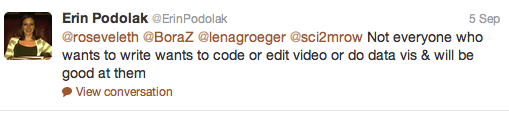
Earlier this week Bora Zivkovic (@boraz) blogs editor at Scientific American tossed out the following links on twitter, and asked for thoughts. Both links were to articles from the Nieman Journalism Lab, the first Want to produce hirable grads, journalism schools? Teach them to code and the second News orgs want journalists who are great a a few things, rather than good at many present two different ways of thinking about the skills journalists need to have. The links started a conversation on twitter (excerpted below) between Bora, Rose Eveleth (@roseveleth) Kathleen Raven (@sci2mrow) Lena Groeger (@lenagroeger) and myself (@erinpodolak) I felt like there was more to say on the topic, so I decided to take it to the blog so that I could respond to everyone's points without the confines of twitter brevity.


I definitely agree with this point from Rose, there are so many different skills you use as a journalist but a lot of what you need to know will vary based on your personal style and interests, what platform you write for, and what topics you are covering. I've found that I learned a lot more from going out and actually chasing down stories than I did sitting in classrooms. Of course, the guidance of journalism school makes learning by trial and error much less perilous than it can otherwise be, so classroom lessons have value too. 


I moaned an awful lot about how scary being turned loose into the unemployed masses at the end of grad school seemed. Journalism has adapted to changes in viewership, platform and the poor economy, and so too must journalists or we run the risk of ceasing to be relevant. Making yourself as employable as possible is a good thing, but only if you are going after jobs where you can really contribute. You'll only be able to contribute if either you know what you are doing or you have the desire and the drive to learn what to do. This thought brings me to the next point I made, not all the skills journalists use will appeal to all journalists. As a profession we can do a lot of different things, but that doesn't mean that everyone wants to do everything.


If you are looking for a job, you have to be honest with yourself and your resume. I think for young journalists there is a temptation to trumpet skills that we only sorta, kinda, maybe have from that two hour seminar we sat through that one time. You can fit what I know about code on the head of a pin, and I've sat through basic training courses multiple times. My resume says nothing about being able to code, because I honestly don't know how. It is always better to be honest about what you know. If you aren't an expert in something, don't claim to be. All you'll do is disappoint possible employers. I think you can go a lot farther being honest about where you are with your skills, if you don't know code but would like to then say so. If you've edited a video once or twice and would like to continue developing those skills then say so. Just don't make yourself into an expert in something when you aren't. 

I recently graduated from the professional track Master's program at the University of Wisconsin-Madison, a program that with only three core courses is left purposely open for students to do their own exploring. So what exploring did I do? I chose to spend my time taking science classes (mostly zoology) learning more about narrative writing and structure, and getting a better handle on social media, personal branding and marketing myself online. All good things to learn while at school, but I didn't learn code. I honestly have zero interest in code, it isn't something I've ever wanted to do, I don't have the patience for it and I feel like my brain just doesn't absorb even the basic information about code whenever it is presented to me. But that doesn't make me an inept science writer. Kathleen Raven  joined the conversation, and brought up the following reason why not knowing code can still be okay.


Part of the reason I think I haven't been particularly motivated to learn code is because I haven't needed it. I was able to set up this blog and my website (www.erinpodolak.com) on Wordpress using basic templates that suited my needs. I'm on Twitter, Facebook, LinkedIn and G+ but none of these online activities involve needing to write my own code. To do what I want to online I haven't run into the need to write code. Kathleen then made another point about a science journalism skill, the ability to do math, which can be overlooked but is important to a writer's skill set. 


Being able to do the math to fact check research reports and call bullshit when necessary is an important part of the reporting that science journalists do for their stories. If you know code but can't do math, you have a critical weakness in your skill set. In my opinion the same goes for being able to structure stories successfully, and handle difficult interviews well. If you don't have the basics, then the extras like code are just floating out there on your resume with no foundation. Being really good at the basics, and then selectively adding skills based on what you find that you need to know, and what you find you would like to know seems like a solid way to go about building your skill set. I think this gets us to the last points that Rose made:


You need to do something that you enjoy. If you don't enjoy code then in my opinion you shouldn't feel like it is an essential skill to have. You might want to be the kind of journalist that can do it all, kudos to you for that. But, I don't think there is anything wrong with wanting to have a few select skills and being really good at them. If you are honest with yourself and honest with employers I think you can definitely learn an array of skills that suit you and your job. We have options, and that is a great thing. Happy times, indeed. 

Note: This is only a brief excerpt from the first few days of this conversation. Much more was said, including more back and forth between Lena, Rose and myself about skills and how to present yourself to employers and from Bora, Lena, Rose and Dan Fagin (@danfagin) about the structure of jschool programs and the balance needed to meet students needs. Still plenty more to say about these topics!

This conversation took place before we started the hashtag #sci4hels to mark all of the tweets. Be sure to monitor the hashtag in the future to see more of the on going discussion between Kathleen, Lena, Rose, Bora, myself and others!

Sunday, July 3, 2011

Scientists Can Be Thought Provoking AND Fun

Scientists can use the knowledge they have to be both moving and thought provoking, but also be charming and clever, getting a few chuckles out of whoever is listening. Case in point: Neil deGrasse Tyson. For those who don't know, Tyson is an astrophysicist and he is awesome. 

On the intersection of science and religion:

On why the Onion deserves a Pulitzer Prize:

Friday, April 22, 2011

War Journalists: Casualties of Their Trade

Its hard to understand why something has the ability to punch you in the figurative gut. Something so far removed from you that it should barely register a reaction. Yet, it steals your breath anyway. That happened to me this week - with a tweet. The offending tweet (from a breaking news thread) said, "Reports: renowned war photojournalists Chris Hondros, Tim Hetherington killed in Libya. Details sketchy; awaiting more."

I don't know why this news struck me so very hard. These are not the first journalists to be killed in a war zone - but Tim Hetherington is the first journalist whose work I have studied to be killed so shockingly, and yet so predictably. It registered. It hurt. Not for me personally, it hurt for everyone who knew him. It hurt for the people whose lives he brought to light. It hurt for the stories he won't get to tell. It hurt because people you admire shouldn't die. Not like that. At least not in a perfect world. But then again, in a perfect world there wouldn't be a profession called "War Photojournalist."

Hetherington is best know for the documentary film Restrepo, which he directed with Sebastian Junger. It was nominated for an Oscar this past winter. I've read Junger's book on the same events as the film - called War, and seen parts, though admittedly not all of Restrepo. It is about the time Junger and Hetherington spent embedded with a group of American soldiers in the Korengal Valley in Afghanistan. My post, Sebastian Junger's War Zone ruminates on the book and on the topic of war. But looking back on it, I can't help but feel deeply how little I know about war.

There has been a lot of coverage of Hetherington and Hondros' deaths, but the People Magazine of it all isn't the story I hope most people will read to find out about these men, and the circumstances under which they died. Sebastian Junger has a tribute in Vanity Fair written as a personal letter to Hetherington that drips with grief and beauty. Susan Orlean has a post in The New Yorker about Hetherington and what it is to be brave. New York Times war correspondent C.J. Chivers has a post on his personal website, Almost Dawn in Libya: Chris and Tim heading home, that pauses amidst the chaos of tragedy to thank the people and groups that tried so hard to save, and then do right by the fallen photojournalists. These are the stories that I hope people will read. It is a tall order to memorialize the fallen, but these writers give it a damn good try.

Saturday, April 2, 2011

Tales From My Twitter

I did it. Took the plunge. Succumbed to the peer pressure. I joined twitter. I think I was inspired by the BronxZoosCobra. One of two things will now happen: I will come to regret it, or I will become addicted. Maybe I'll get more twitter followers than blog followers (not that I don't love the seven of you immensely.) Here goes my shameless plug: http://twitter.com/ErinPodolak

Fun fact, within 20 minutes of joining twitter, my first follower became Sea World. Nothing against Sea World, I'm just not sure what their interest says about me. Do they follow every person who claims to be a science writer? Or did I just do something special to garner their attention? Fellow science writers, please advise.

***
Update 4/8/11 - Six days on twitter, and I've lost Sea World as a follower. Sad day. I guess my tweets weren't of interest to them after all. But I do have 10 whole followers, putting my twitter prowess ahead of my blogging prowess by three.

Update 4/18/11 - Complete and total obsession has taken hold. Twitter has bested Facebook in the struggle for my two-second attention span, and I am overwhelmed by the wealth of information I didn't realize was being traded everyday. I have made it to 22 followers, only five of whom I actually happen to know. I have been Re-Tweeted by the Canadian Research Office - much to my amazement. I am both humbled and nervous about what my tweets will say about me. In my worst nightmare my budding career is brought down by using the wrong #hashtag and offending someone I never even knew existed. Perhaps I am taking my life on the internet far too seriously. It may be time to back slowly away from the laptop.

Thursday, February 3, 2011

Finding A Place For Al Jazeera

Chaos has erupted in Egypt this week as protests calling for the removal of the president Hosni Mubarak turned violent. I do not mean to say that the conflict is as simple as pro or anti government groups, I know it is a complex issue. But as a disclaimer, I'm not a political writer, or an international relations writer.

The reason I bring up the conflict in Egypt is because I read a very interesting opinion piece on Al Jazeera English: US viewers seek Al Jazeera Coverage which says that the conflict in Egypt has led to a considerable increase in the number of people from the United States choosing to get their news from Al Jazeera. I think Al Jazeera is a very interesting curveball for the broadcast news industry that we should be watching.  

The article and comments section make the case that other news outlets (MSNBC, CNN, ABC, CBS) have done a poor job of covering Egypt, while Al Jazeera has excelled. The claim that American coverage is lacking is convincing. More people seem to know that Anderson Cooper, Christiane Amanpour, and Katie Couric were attacked by the protesters than they know about the causes of the conflict (myself included). 

For those who are unfamiliar, Al Jazeera is the dominant news outlet (television and internet) in the middle east, and is popular all over the world. Except here. Cable providers in the United States have largely chosen not to pick up Al Jazeera. Some say this is because the audience isn't interested in Al Jazeera and the cable companies would lose money. Some say that Al Jazeera has been blacklisted for being sympathetic to terrorists. 

But for those who want it, Al Jazeera can be streamed live online which gives many Americans access even if it is not a choice on the television. Al Jazeera has dominated coverage of the situation in Egypt for several reasons, namely because they were already there and they know how to operate in the country. 

I visited the headquarters of Al Jazeera English in Washington D.C. with a college group in 2009. They actually let us in the control room during a live broadcast, and gave us what I consider to be a lot of access to their newsroom. The opinion piece I mentioned above is definitely something to think critically about, and consider the points for and against broadcasting Al Jazeera in the United States. 

The comments section on the article brings up some really great points about how Al Jazeera is seizing the opportunity to play up the "discrimination" against them by American viewers and also how Al Jazeera is a legitimate news source that Americans deserve access to. Internet is good but Americans get their news from the TV, and until Al Jazeera is given a channel the network just isn't going to take hold in the United States.

Check out Al Jazeera's coverage and let me know what you think. I'll be watching to see if the situation in Egypt gives Al Jazeera the momentum it needs for a cable provider in the US to pick up the network. 

Wednesday, January 26, 2011

Saving Journalism, One LOLCat At A Time

I got sent this article today from a professor: Time for change in science journalism by John Rennie for the Guardian. Rennie is the former editor and chief of Scientific American, and currently blogs for PLoS (Public Library of Science) - which has a great blog network for those who are interested.

He makes an interesting argument that the way science journalism operates like breaking news journalism is inadequate. Having to write on deadline and keep up with what is new to oust the competition doesn't work when reporting on science topics because it doesn't leave enough time to report on new findings in the overall context of the field.

I appreciate his humor in the critique of what science journalism needs to improve, "My vehemence sprang not just from enthusiasm for the improvements possible through linking to primary sources, fostering dialogues with readers, incorporating multimedia and tapping the awesome power of LOLcats." Hilarious. But I also agree with his point.

Writers need time to thoroughly research a new science finding in order to craft stories that are unique and not just cookie cutter turn outs from press releases. Science journalists can do better, and having turned out some press release dependent fluff myself, I know that we can do better. If the comments on Rennie's article are any indication, there is an appetite for good science news, now we just need to step up to the plate.

We'll just have to be sure to fill up on inspiration from those lolcats first...


Tuesday, January 25, 2011

Can Journalists Be Celebrities?

I've been thinking a lot lately about the distinction between television news personalities, and print/internet journalists. I feel pretty strongly that being a TV news anchor, doesn't necessarily make you a journalist. But then what does make someone a journalist?

With the "sudden" departure of liberal commentator Keith Olbermann from MSNBC's program Countdown last week, I think the issue of journalists as television personalities, and ultimately as celebrities has been brought into the spotlight. Olbermann has been in trouble with the network for donating to liberal political campaigns, which would be a big no-no for a journalist because it would be a clear violation of the need to be unbiased. But Olbermann has never been unbiased. He has always made his affiliations clear, so does the fundamental journalistic quality of trying to be fair go out the window? If we don't hold him to journalistic standards, does he then become nothing more than just a television star?

Where do we draw the line between Matt Lauer and Anderson Cooper? Are they both journalists? Are neither of them journalists? How does being on television make someone different from a print journalist? How many print journalists do you know by name? If I had to guess, I'd say not that many. I ask these questions because I think there are important distinctions between journalists that people need to be aware of. But at the same time, I'm not sure that I can quantify what it is that makes or discounts someone from being a journalist. 

When I think about television journalism, I automatically think that Anderson Cooper is more legitimate than your typical nightly news anchor. But is this just a reflection of the way he is displayed on TV? Is he really a journalist in the sense that he develops stories, cultivates sources, does the digging and background research necessary to make a story? Or does he send an intern off to do the real journalism and then just read the cue cards? I certainly don't know how Cooper operates, but I think its important to consider why he seems so much more like a journalist than the people who read the news every night on television. 

Print journalists are rarely as recognizable as television personalities. Does that make print journalism more legitimate? For whatever reason, I feel a bias against people on television. If someone wants to be a television star, I don't consider that the same as wanting to be a journalist. But why can't a journalist also be a television star? What is it about TV that somehow cheapens what may very well be outstanding journalism?

Perhaps it is nothing more than the difference between an editorial and an article. But then why do the people who read the news on television (which would count as articles) not seem like journalists, when someone like Cooper who can easily cross into the realm of editorial seems legitimate? Especially when the Olbermann's of the world, who are clearly editorialists, have so obviously crossed the line between journalist and television talking head. 

I'm not sure. But as I figure out what kind of journalist I want to be, and how I want to direct my career, it is definitely something that I'm thinking about. 

Some background on the Olbermann/MSNBC split:

Wednesday, December 15, 2010

The Ever Important Role of Facebook

Given that I check my Facebook at least a dozen times a day, I think its safe to say that I'm an addict. The more Facebook changes and expands, the more addictive it seems to become - especially with the evolution of the news feed.

This week my professors and colleagues pointed out several examples of social media, particularly Facebook, playing a role in how hard news stories are reported. I think it is definitely safe to say that Facebook is another tool in a reporter's arsenal to get the scoop on a story, or even just to get a good feel for a situation.

One article that I found particularly jarring because of the way it used Facebook is Ian Shapira's article for The Washington Post, A Facebook story: A mother's joy and a family's sorrow.

In addition to seriously pulling on the heartstrings, I think Shapira's article also dances around the issue of what happens to your online presence after you die. The issue of "digital death" was raised by my colleague in the UW pro-track program, Marianne English in the article: Madison startup Entrustet helps people control their digital assets from The Isthmus.

Things to think about.

Thursday, November 11, 2010

What Makes A Cat Tongue News?

Ok, so earlier this week I questioned what made the study on cricket testicles news, and now here I am again questioning why a scientific find is in the news, courtesy of the BBC.

Mystery of how cats lap is revealed by Rebecca Morelle is really stretching it in my opinion. I can understand how you might observe a cat lapping up water and be curious about how they do it so well, but I really don't see why this is breaking news. Perhaps it is a slow day for science?

Source: Wikimedia Commons.
When did the biggest scientific discoveries become cricket balls and cat tongues? Can't we do better than that? Aren't we? We spend millions of dollars on research, how are these the best stories out there (and I assume these must have been best as they led the BBC's science coverage on the days they each ran)?

I am going to go out on a limb and say that stories like this are caused by the need to publish something (ANYTHING) quickly. With the internet it is shifting from the quality of a story to the number of stories that you can produce. I think its sad that the best the BBC is putting out is high speed video of a cat drinking as their science news. This isn't going to entice readers to start giving a damn about science.

We can't just cover every single scientific finding. As journalists it is our job to determine what stories are the most interesting, to track down obscure threads and follow them until you get a story that no one else has, and to inform the public about the scientific findings that they need to know about. I think there are very few people out there that would say they really needed to know about cricket testicles and cat tongues.

Seeing stories like this makes me want to change the journalistic system. I don't blame the writer, she wrote the story she was assigned. I blame the fact that no one is willing to spend the money on investigative, in depth reporting anymore. Give reporters the resources, and we'll deliver the goods. Without the support journalists need to get the good stories, you're gonna get cricket balls.

Wednesday, November 10, 2010

Scientists Peer Into Their Crystal Ball

One of the stories highlighted on the science pages of the New York Times this week is a multimedia piece called Voices: What's Next in Science by Carl Zimmer. I think the piece is interesting to note because it uses audio clips, pictures, and short write ups to give an overview of what scientists in a variety of disciplines predict will be hot topics in their field in the coming year.

The scientific areas featured are Space Science, Conservation Ecology, Ocean Science, Game Design, Climate Change, Genomics, Neuroscience, Engineering, Biotechnology, and Mathematics. I found these choices a little puzzling. What about stem cells, or biomedical research as a whole? The piece includes engineering and mathematics but ignores physics and chemistry, why? Also, while I find science gaming interesting and I think its a great new field for encouraging people to become interested in science, I don't see how it fits in with the other specialities.

I also find it interesting that they use the term conservation ecology, which is specific and scientific, but then they use the term ocean science as a lump term for all the specialities that involve the ocean, and the same for space. It doesn't really seem cohesive for me to flip flop between specific and general.

The audio clips, and the fact that the write ups are so short make this a very accessible article that I think even people who don't typically read science news could be interested in. It is a good example of how to use multimedia, without having to go terribly out of your way as a journalist.

Tuesday, November 2, 2010

Harry Potter: Scourge of the Owls?

New research out of India is drawing a correlation between a spike in the black market trade of owls and the popular Harry Potter books and movies. Apparently the stories, which feature a white owl (named Hedwig,) have led to a surge of people seeking owls as pets, as well as for what the BBC calls "black magic" rituals.

Source: Wikimedia Commons.
As a reader, I am interested in the research methods used to draw the correlation between the loss of owls and Harry Potter. I wish the article talked more about how the researcher came to his conclusion, because simply noting the popularity of a series that features an owl as a minor character (I think its minor, I've never actually read a single one of the Harry Potter books) is a far cry from actually quantifying its connection to a decrease in owls.

This type of investigation reminds me of the correlations made between video games and violence, or metal music and violence. I think that how studies of this type are conducted is a pretty important component to the story, because simply stating that something is a significant relationship doesn't make it so, I want to see the numbers.

From the BBC: Harry Potter blamed for fueling India owls' demise

Wednesday, October 27, 2010

Trouble in MarieClaire's Blogosphere

Now, I'm not a fashion or lifestyle writer but I think the controversy over MarieClaire blogger Maura Kelly's post "Should 'Fatties' Get A Room (Even On TV)" is worth mentioning. Kelly is a professional blogger, her career is posting her opinions on the internet. But, by coming out with the opinion that fat people shouldn't be shown in intimate scenes on TV because it grosses her out, she has caused a firestorm. The controversy has raised a lot of questions about professionalism in the blogging community.

I suggest you read her article, and then review the comments posted below it by readers. As a blogger it is all well and good to share your opinions, but where do you draw the line? Kelly is a representative of MarieClaire - not just of herself. By branding MarieClaire with her opinion she has apparently cost them a tremendous amount of business (if you believe the comment writers, at least). What standards do magazines and other companies use to hire bloggers? Are there any standards?

In the apology that she added to the original article, Kelly brings up that she suffers from anorexia and has had a life-long obsession with being thin. Hmm. That might have something to do with why she finds it unacceptable for overweight people to get romantic. Crazy thought, that MAYBE her personal background should constitute a conflict of interest and she should never have be allowed to blog about weight issues in the first place. As a writer, it was her responsibility to identify that conflict of interest.

Even if you feel you can be objective, you just can't write about issues with which you have a personal connection without disclosing that information properly. I can't write about issues involving law enforcement because so many members of my family are involved in that career field -- it is the reason I will always get tossed off jury duty. It gives me bias. As a writer you have to know yourself, and be honest with your readers about your personal conflicts of interest when they are applicable to the subject you are writing about.

But is a blogger really a professional writer? I am very interested in Ms. Kelly's background. Does she have a journalism degree? Does she do any research, or does she just spit out her own opinions? Why should anyone care what she says? Who is Maura Kelly? What makes her qualified to eschew her thoughts on an issue like popular conception of body image in the entertainment industry?

I wish someone would pay me to say whatever thoughts cross my mind. Maybe they'll be an open position for blogger at MarieClaire sometime soon? I wonder if they need a science writer...

Saturday, October 16, 2010

Giraffe Love

Giraffe at the Henry Vilas Zoo Madison, WI August 2010.
Credit: Erin Podolak
Now I know special interest stories are important, getting the personal angle that appeals to the audience's emotional side is a great way to sell as story, but now the BBC is writing about giraffe love? I think everyone will sleep easier tonight knowing the Gerald the Giraffe has a new girlfriend. To think people are worried about the future of journalism. Bachelor giraffe in bristol finally gets a girlfriend.

Wednesday, October 13, 2010

Chilean Miners

In case you happen to never turn on the television or read any news of any kind, here are a few links to the story of the 33 miners in Chile who have been trapped underground since August 5th. Rescue workers have been pulling the men up above ground one by one since late last night.

The LA Times: In Chile 21 Miners Rescued and Counting
The New York Times: Chile Rejoices as Capsule Brings Miners to Freedom 
Washington Post: Chile Mine Rescue Underway, Two Thirds Hoisted to Safety
Chicago Tribune: Chile rejoices as two-thirds of trapped miners freed; men look healthy after 2-month ordeal

You get the idea...

From a strictly media perspective this story is important because:
A. There are THOUSANDS of reporters from around the world who have descended on Chile to await the rescue of these men to get the first pictures, sound bites, video, etc.
B. This could have been a tragedy, but instead is an uplifting story of survival and hope -- how often does anyone get to write a story like that these days? Answer: Not very often.
C. This story has such significance because so many men were trapped, because they are all alive, and because they are all alive after being underground for over two months... its just plain shocking.
D. There are dozens of story angles that can be pursed from this one event. For a reporter with the means, and incentive this event is a journalistic piƱata... so many pieces of candy are now raining down on journalists everywhere in the form of story ideas.

The follow-up to this event is going to be spectacular. I am excited to see who gets the movie rights.

Saturday, October 2, 2010

Can't We All Just Play Nice?

One of the big topics right now in the media business is the dismissal of CNN's Rick Sanchez after he went on a satellite radio show and called Daily Show host Jon Stewart a bigot, and criticized the role of Jews in the media, saying as a group Jews do not experience derision like other minority groups.

I may be a complete and total journalism newbie, and this deals with TV news which is not my specialty, but I have to say that to me, Sanchez's remarks are no better than elementary school taunting, and I for one am glad that Jon Stewart is just refusing the play (the Daily Show has declined to release a statement about Sanchez's remarks.)

Stewart's New Book
Sanchez went on air and mistook the Galapagos Islands for Hawaii when covering the Chilean Earthquake that occurred in February 2010. He made a factual error which he should take ownership of, its not ok for journalists to not know what they are talking about, and its really not ok to give misinformation. It also wasn't the first instance of Sanchez making a factual error. So Jon Stewart called him out and made fun of him for it. Deal with it, that is what the Daily Show does.

The concept behind the show is pointing out the inadequacies in media, politics, science, etc. A lot of "rich white guys" have been called out by Jon Stewart too, he didn't highlight Sanchez's error because he's hispanic, he highlighted it because it was an unacceptable mistake. To say that Stewart did it because he's a bigot just shows that Sanchez is also ill-informed as to what the Daily Show does.

The other half of Sanchez's argument - that Jews in the media have all the power - really? Because no one has ever heard that one before. Get over it. Its like arguing on the playground because someone has a better toy than you do. So someone has a better toy than you Rick Sanchez, be creative and maybe you could have more fun instead of lamenting that fancy toy. But no, you decide to whine about it. Because people will respect you more for taking the low road (sarcasm intended.)

Here's a fun idea, how about instead of accusing someone of being a racist every time they point out that you made a mistake, you rise above and be better? Stop making mistakes. Don't give anyone fodder to try to take you down with. The media and the public would be better off. No one wants to hear about how the kids on the playground were mean to you.

Lisa de Moraes' article in the Washington Post about the Sanchez-Stewart incident: CNN's Rick Sanchez Fired After Explosive Interview on Satellite Radio. 

Monday, September 27, 2010

That British Sense of Humor

I have to give Deb Blum credit for passing around this article from the Guardian that spoofs science writing. Anyone who has ever written or read science news should read it. It crushes my soul but gives me tremendous hope all in one fell swoop. Essentially, 99.9% of science news is less than stellar. At least now keeping myself out of this category is something I can strive for.

The comments that follow the article are equally hilarious and actually really add to the article, completing the satire of web media and public interaction.

My favorites:
"This is where I forgot to say that 99% of other scientists researching in this field disagree and think this scientist is a nutter" (I love that this person used the word nutter)
"This comment is simply an inexplicable and unrelated reference to Hitler"
"THIS COMMENT IN CAPITALS WILL DEMAND THAT SOMETHING BE BANNED"

This whole thing had me laughing out loud. A win for Martin Robbins.