Showing posts with label Grad School. Show all posts

Friday, February 8, 2013

Blogging 101 Here's What I Know

Not that I expect anyone to want to take the 20 minutes to watch a video that is essentially just me talking, but I recorded this interview about tips for bloggers who are just starting out so I thought I'd share it here. This was done as a prelude to a guest lecture that I gave in a Life Science Communication class at the University of Wisconsin-Madison. The students asked some great questions, that I figured were also worth answering here on the blog. If you have questions about getting started as a blogger or want to add some wisdom (please, do!) definitely let me know in the comments.


Questions from the class:

Has your strategy for promoting and writing the blog changed since getting a full-time job?
Absolutely, I have less time to maintain the blog than I did when I was in school, so I have to be more strategic about what I do. I'm down to writing one post a week and I spend a lot more time on Twitter. 

How do you find and pick which topics to write about?
For a more detailed answer about this one, you can check out Filling the Empty Page: Reading to Write where I talk more about how I get story ideas from the things that I read, and how important it is to write about what genuinely interests you. 

If there is one thing you could have done differently what would it be?
I would have (and still should) comment more on other blog posts. This is a case of not practicing what I preach, I'm well aware of the benefits of commenting and getting involved in other forums, I just don't do it nearly as often as I should. 

Is there a certain way you suggest commenting? As in: ask questions, critique, converse, praise, etc.
Comment however you want to, just make sure you are saying something that contributes to the conversation in some way.

How do you make yourself seem credible when writing about a serious matter?
If you check your facts, use the right sources, and are thoughtful and dedicated to getting the post correct then you are credible. People will see that. 

Are you using other social media sites besides Twitter to grow your blogging audience?
I just started using Google+ more, I'm intrigued to see what comes of it. 

Any advice in finding your blogging voice?
Blog a lot. When I first started Science Decoded, I wrote a lot more than I do now. You need to try it out, try different kinds of posts, explore different topics and eventually you'll figure out what feels right to you. Give yourself time to develop your voice, you aren't going to have everything exactly how you want it right out of the gate. 

Any tips for reaching out to influential stakeholders, it seems intimidating.
If tweeting or commenting to someone well established in your field, I think the best advice I can give is to just go for it - but have something of substance to say. If it really makes you uncomfortable, practice interacting with people you consider your peers first to get a better sense for how it all works. 

After you established a professional blog did you ever find yourself posting off topic of your specific aim because it was just so interesting you had to share it?
Absolutely. I kept Science Decoded fairly open ended in the first place because I knew I wanted the ability to write blog posts about a variety of topics. Even so, I've written posts that haven't been related to science like when I went on a rant about supporting philanthropic causes or explained my fascination with Amelia Earhart. In my opinion, you can go off topic once in a while and you shouldn't have a problem.

How do you keep your ideas confined to a tweet?
Tweeting short hand is tricky, it takes practice to instinctively distill ideas into a tweet but you'll get the hang of it. 

What aspect of your writing has improved most over the years? (being concise, structure, etc.)
I would say the thing about my writing that has improved most since I started blogging is the ease with which I write in my own style. Like I said in answer to another question, your voice develops and becoming comfortable with my own voice is I think the best take-away from blogging. 

If you have any tips of your own, or if you have any other questions you'd like me to try to answer leave it in the comments! 

Monday, May 21, 2012

The Final Countdown: Closing Time

Tonight is my last night in Madison. I've said a lot of goodbyes in the last week, but none that felt particularly adequate. Most people just got a half hearted wave before I ran away, if you were very lucky you got a hug before I ran away. I'm not very good at goodbye indefinitely. It might actually be worse than goodbye forever. So, I've decided to take to the blog once more to try to say goodbye.

I vividly remember walking through the security line at Newark airport sobbing because I didn't want to leave New Jersey. My friends were there. My family was there. All I knew was life on the East Coast. That first time that I had to get on the plane alone and fly to Wisconsin was the hardest. Every flight after got a little bit easier, to the point where I was happy to head back to Wisconsin. That change happened due to the people I now count among my friends. It happened because of the places here that I came to love. That change happened because I changed.

Sometimes it is hard to explain what I gained in Wisconsin without making my life in New Jersey seem lacking. That certainly isn't the case. The bulk of my support system is in New Jersey, my family and the good friends who came along on this ride with daily gchats, emails, texts, and phone calls. They are the people who matter most to me, and I couldn't have done any of this without their support, advice, and encouragement. But that being said, my time in Wisconsin was truly everything I never knew I needed.

I didn't realize how close I was to giving up on journalism and science writing. It has been my dream to write about science since I was a kid, but in 2010 I was ready to give up. After the graduate school rejections, a full year of fruitless job searching, and working my ass off for free I came to Wisconsin on my last legs hoping dearly that journalism school would save the dream I saw imploding. It didn't, particularly. Don't get me wrong, I learned a lot. But classes themselves are not the stuff that dreams are made of. People make dreams. What saved mine was the professors who told me that my voice matters and is strong, the classmates who pushed me forward sharing my frustrations and successes, the wonderful journalists and speakers who gave me their attention and shared advice, and all the other people who remind me everyday on Twitter and on this blog and theirs why I love doing what I do. All of you contributed to bringing my dream back from the brink.

When people ask what comes next for me and I tell them I'm job hunting the answer I almost always get is "good luck, it's tough out there." Yes, it is. But I'm tough too. I'm more determined than ever to break into this field. Sometimes there are no open doors or windows, sometimes you have to burrow under a wall or scale the roof to get in. Sometimes you have to wait, or go back and draw up a new plan. I will not stop writing. I will not stop meeting people, or chasing the stories that interest me. I hope someone will pay me to do so, but if that doesn't happen for a while I'll just keep doing it on the side. I'll keep trying. That is what I promise all of the people who have supported me and who believe that I can do this. I'll keep trying. Wisconsin, the people I met, and the experiences I had living out here gave me the strength to try and to keep trying. I feel like I've gotten a part of myself, the feisty determined and confident part, back.

It is easier to leave a place, a time, a chapter in your life that you love and want to hold onto, when you know what comes next. I have no idea what comes next. Immediately I know that I'm moving back to New Jersey to stay with my parents until I find the kind of employment that comes with health benefits. But what that job will be, where it will be, and what I'm heading into, I don't have a clue. That sort of seems fitting though. I had no clue what I was getting into when I decided to move to Madison, picked an apartment site unseen and agreed to live with a total stranger. That stranger ended up being the single most encouraging and sympathetic person in my life here and I will miss my roommate immensely. She made me laugh more than any other person whether it was at her, with her or at myself.

There is something I love about the unknown. If life was always tied up nicely in little packages, all planned out according to what everyone expects you to do it would be insufferably boring. The unknown holds the promise of an adventure the details of which you can't see or understand. It is hard to say goodbye when you don't know what comes next, but not knowing is life's way of keeping things entertaining. You know I like to be entertained. So, it makes sense to me that I don't have it all planned and figured out. I think that the most interesting lives are the ones that meander, the ones that don't take a linear path. I want tremendously to succeed, but if I end up taking the long way to get there it will be okay. It might even be better than okay.

So tonight, as I look around my empty apartment, I propose a toast to dreams rekindled. To irreplaceable friendships forged over coffee and those Wisconsin beers. To going home again, better than when you left. To people who never let you forget that you matter. To getting what you need instead of what you want. To making your own opportunities. To the unknown. Cheers.

I'm so fortunate to have spent this part of my life in this place with these people. I wouldn't trade the depression and tears or the joy and laughter for anything. As much as we might want to slow time down and hold onto a moment, we have to let moments pass. My moment in Wisconsin has passed, and it's time to move on. On to the next adventure. There is a lot about Wisconsin that I'm going to miss dearly, but I'm ready to meet whatever comes next. So goodbye, and thank you.

Thursday, May 17, 2012

Lessons From Neil deGrasse Tyson

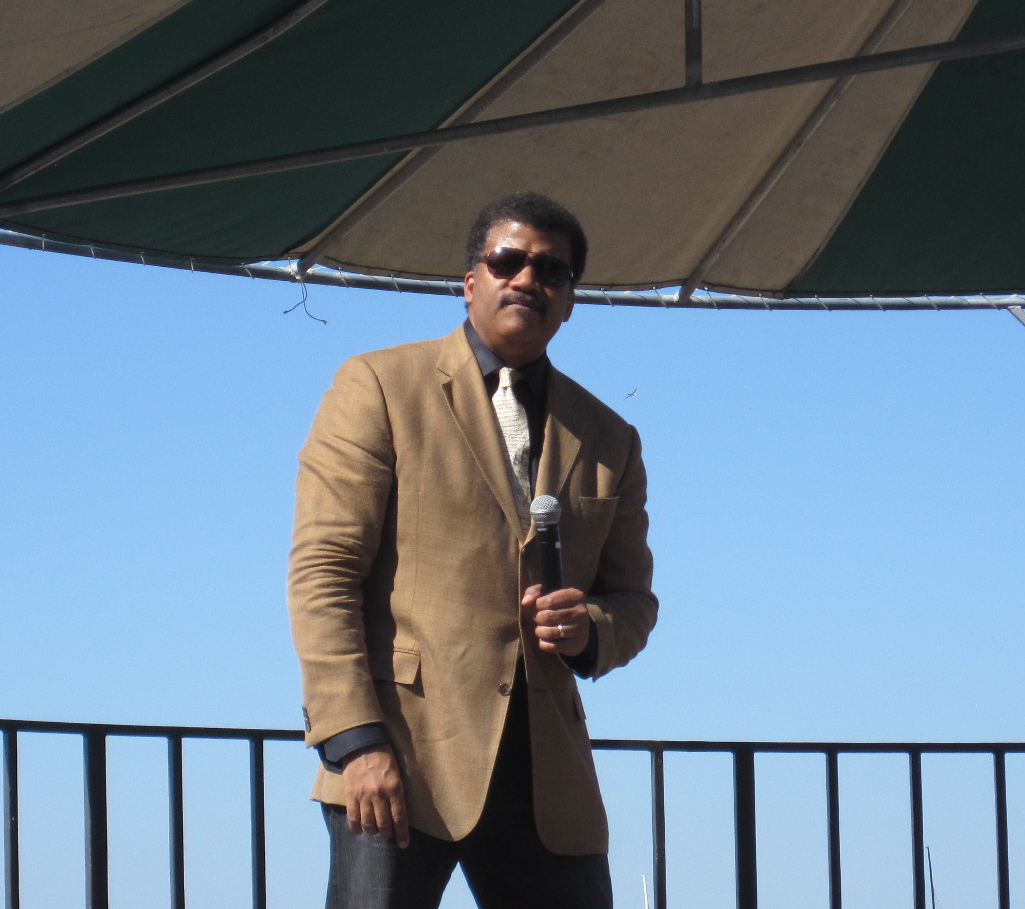
On the day I attended the last college class of my higher education experience, I also attended a talk given by astrophysicist Neil deGrasse Tyson. For me, it was my commencement. I've made the decision not to walk at graduation for a number of reasons chief among them that none of my colleagues are walking and it didn't make sense to me to do it alone. So I won't be getting the cap, gown, prominent speaker send off typical for most people who complete a Master's degree. Still, the University of Wisconsin-Madison gave me a great parting gift. The opportunity to sit at my favorite place on campus surrounded by other students on a gorgeous day and listen to a person whom I have admired for years talk about the future is the best goodbye I could have asked for.

Neil deGrasse Tyson is an astrophysicist (please don't ask me to explain astrophysics further than saying it is physics in space) at the American Museum of Natural History but he is also an author, speaker, host, and even a meme. You might have seen him on the Colbert Report or the Daily Show throwing down some truth and clarity. He is eloquent, funny and honestly one of the people I admire most in the field of science communication. He pulls no punches, while still being extremely passionate about space and all the other STEM (science, technology, engineering, and mathematics) fields.

The talk, which took place 5/10/12 on the Terrace here at UW-Madison, started with Tyson talking about the role science plays (or lack thereof) in our culture. He used the example of money, by asking us which scientists appear on U.S. currency. The answer is none. You can make the argument that Benjamin Franklin was a scientist, but his experiments are not what is highlighted on the $100 bill. He is there for his political achievements. This is just an example of the way as a culture we have not placed a strong emphasis on science.

Tyson then went into talking about the history of the U.S. interest in space exploration. He said that historically there are three reasons why people invest a lot of money in a risky exploration: fear of death, promise of economic return, and praise for royalty and deities. If you look at the U.S. push to get to the moon we were acting under #1 fear of death. Our investment in NASA and the space program had everything to do with the Russians and the Cold War. When the communist threat was gone, the space program started to decline. I think Tyson really drove home this point when he said that if the Chinese decided to declare that they were building military bases on Mars the U.S. would get ourselves on Mars within 10 months. We could if we wanted to, we just don't invest in the necessary programs. We need to feel threatened before we actually do anything, how very American of us.

After going through the history of the space program, Tyson started talking about the economy and why investment in space and science overall can help. People in general seem to have this impression that NASA gets a big chunk of the federal budget, but Tyson pointed out that if NASA actually got what people think it gets NASA would be rolling in it. The perception of the budget is pretty skewed. What I love most about Tyson is that he says things that just make sense. When talking about innovation he said that the way you keep jobs in the U.S. is by making things that no one else can. Well, duh. But then where is the big push to invest in innovation? We aren't doing ourselves any favors by not trying to invent. Perhaps my favorite line from his talk (which was full of quotable one-liners) was "If the dinosaurs had had a space program, you can bet they would have used it" basically about how to save us from ourselves.

Seeing a speaker like Neil deGrasse Tyson meant a lot to me. He lived up to the hype. I was impressed with the caliber of his ideas in addition to his stage presence and the great dynamic he developed with the audience. All of us sitting there, the sea of students strewn on the concrete in front of the stage, get to walk away from this year at UW-Madison having heard from a man who is without a doubt one of the biggest bad asses in science communication. I mean he paused at one point to tweet his own talk (@neiltyson) that takes some cojones and an awesome sense of humor. It was a great experience, and I can't wait to read Tyson's new book!

Also you should watch this because well, it is astounding:

Thursday, May 3, 2012

The Final Countdown (Part IV): Time To Panic?

Dear readers, please excuse me while I have a quarter life crisis. We'll get back to your regularly scheduled science writing posts momentarily. The last few weeks have seen such a mix of emotions, that it seems necessary to collect them in a blog post as an update for my semester long series about graduation and saying goodbye to Madison. So here is a self indulgent list of all the thoughts ricocheting in my brain. My hope is that a post like this chronicling the weird, pathetic, and hopeful thoughts of a graduate, a graduate school graduate mind you, about to be turned loose in the world will be one that others can commiserate with. I'm taking this to a blog post just to tell you that you don't have to worry, there are other people out there freaking out. I am one of them.


  • I did not appreciate how amazing and wonderful the city of Madison is nearly enough. Now that I'm leaving it, now that the flight is booked, now is when I start to love it. 
  • Having attended a small private school and now a large state university I can say that they each provide a very different experience. I'm glad to have gotten a taste of both. 
  • The one thing I am dreading most about presenting my final portfolio to my peers is that in our presentation we have to include our "what's next" plans. I do not know what is next, but I take comfort in knowing that I will not be the only person up there who doesn't know what their future holds just yet. 
  • The last two years alleviated the sense of failure I felt at not getting a writing job in New York City. It made everything okay because I was a graduate student. Being a graduate student was not the solution to a problem, it was the postponement of a problem.
  • Everyone keeps telling me that I am young and I have time. I'm 24, and it is young, but its not that young. I was supposed to have traveled the world and written a memoir by now.
  • I am 24 and I have a Master's degree. So I didn't write the memoir, I wrote a lot of other things! That's pretty good right? Right. 
  • It makes me frustrated to see jobs that I really feel like I could be great at require years of experience. You are supposed to do internships to get experience, so why does everyone act like my four internships and two part time writing jobs held while going to school don't add up to three years of experience?
  • I do not know how to become "successful" in terms of finding a job that will pay my bills and make me a grown up and also become "successful" in terms of not abandoning my dreams and being happy. I desperately want them to be the same thing. I do not think I will get so lucky right out of the gate.
  • I do not know if being someone that everyone who has invested in me can be proud of, and being someone that I can be proud of are going to be the same thing.
  • How are you supposed to know the difference between following a dream that is a fool's errand and following a dream that you can really make happen? Perhaps I am just an inspired fool. 
  • The decisions I make now feel like they will impact forever. Everyone, including those older and wiser and those younger and wiser keep having to remind me that you can change your mind, change your job, change where you live, change who you know, and change what you know. 
  • I want to ride an elephant, go to borneo, get a tattoo and jump out of an airplane. The last two are much more likely to happen than the first two.
  • I also want to have a car, pay my rent, buy food, and otherwise be a grown up and stand on my own so my parents can retire in peace.
  • Does going back to a place mean you will go back to who you were when you were last there?
  • Who I am now and who I was when I left New Jersey is not the same person. I feel the most like me that I have in a long time. The only crisis I am not having is a crisis of self. I am confident, relaxed and certain that it will all work out while still being certain that I'm going to stumble along the way as it is inevitable. 
  • There are other people out there who are smarter than I am, who are better writers than I am, and who if I was doing the hiring I would probably hire before myself. These people understand how to properly use commas. I will probably never understand how to properly use commas. 
  • I am still smart, a good writer, and willing to work really hard. I am also still idealistic enough to believe that if you work really hard you can make things happen. 
  • I am one of the luckiest people I know. I have had such amazing opportunities, among them attending two highly respected universities. I am incredibly grateful to my parents for financing six years of education and for telling me to go after science writing with everything I've got.  Without them I would be living in a cardboard box with a sign that says "will write blog post for food." 
  • I am incredibly grateful to the University of Wisconsin-Madison for being everything I never knew I needed. There is really nothing like the insight and knowledge you can gain on a college campus, especially this campus. 
  • I don't know that I could ever get tired of the view from the Terrace. Honestly, I've never been on a more beautiful college campus, and I was very much in love with Lehigh's.
  • The amount of people rooting for me is seriously humbling.
  • Selling oneself in the form of a cover letter is awkward. It never stops being awkward. 
  • If I had my college years to live over again, I would do a lot differently. If I hadn't lived it the way I did, I wouldn't be who I am or where I am. Thus I would not be the person that would live it the way the person I am now would. We do not get do-overs, so must find a way to be content with what was.
  • Regardless, in each case my undergrad and graduate school experiences resulted in wonderful memories, great friendships, and more fun than should be allowed. 
  • The second time around, I actually feel ready to graduate. 
  • The amount of opportunities, of change, and of chances that lay before me is another reminder of how lucky I am. I can go anywhere, and do anything and I will still have a cheering squad behind me. This includes running away to Borneo or getting a full time job with health insurance. 

I can't say that everyone who is graduating will feel the way that I do. I'm quite sure some of my thoughts wouldn't have crossed your mind, but I do hope they show you that being optimistic and confident doesn't have to do with having all the answers. Sometimes it is just as important to have the questions, and to know that you have what it takes to find the answers...eventually. I don't know what I'm going to be, or where I'm going to be but I can't wait to find out. 

Final countdown: T-11 days until my last assignment is due, T-19 days until I move back to NJ. Now, here is some Bon Jovi for you, and while we're at it here is a little Passion Pit and some Red Hot Chili Peppers, the Goo Goo Dolls, Matchbox Twenty, Eli Young Band, Semisonic, the Talking Heads, Lady Gaga and the Killers because every crisis, especially those in your mid twenties should have a soundtrack. 

Monday, April 16, 2012

A Science Writer's Mistakes

Do as I say my friends, not as I have done. Recently I read this post by Genomic Repairman (@genomicrepairman) in which he provides 10 basic tips for grad student science bloggers, which are really just good tips for any novice blogger. I also read this post about whether or not science writers should always read the academic paper they are writing about, something I try my best to do but haven't always done. These two posts inspired me to assemble some of my own tips and thoughts about science writing. I've made the executive decision to frame this post around the stupid things that I've done, in the hopes of helping writers new to the blogging scene avoid my mistakes (so that they can make their own, of course). Also because it is always more interesting to know how someone has messed up than to hear them talk about how great they are. So I've decided at the risk of public embarrassment, to bare my little science writing soul and share three of the things that make me shake my head at my own silliness.

This is not me, but it is a nice stock photo no?
via Wikipedia Commons, Harumphy
1. Comment on other people's blogs. I read between 5 and 10 blog posts a day, yet I am terrified of adding comments for fear that I will sound like a moron. I have written more than 200 posts here, but leaving a sentence in the presence of the likes of Carl Zimmer scares the hell out of me. I can't tell you how many times I have written a comment, stressed out about it, re-written it, stressed out about it some more and then deleted it completely. I've heard over and over that you shouldn't leave comments unless they serve a purpose, otherwise you aren't adding to the discussion. However, most of the time I feel like I just want to say "I like you" "I like this" "This is really smart" and thus I end up saying nothing. This is problematic for two reasons, the first being that people I admire put themselves out there in a way that allows me to tell them I admire them and I never do. The second reason is that I can't very well expect people to leave me comments if I never comment on anyone else's site. I have a new resolve to get involved in the conversations, but new bloggers should train themselves to comment before they become comfortably silent. Make a habit of it, so that you don't have to break a cycle of complacency later on.

2. Put an RSS feed and subscription options on your blog. Simple enough. People want an easy way to filter through all the blogs out there, and if they can't subscribe there by RSS or email the odds of them obsessively checking your site everyday to see if you have a new post (especially if you post sporadically like I do) is slim to none. Why did it take me a year and seven months to put these things on Science Decoded? Hell if I know. I guess I figured, well I have all the share buttons so that's good enough right? No. No, it is not. I should have had RSS and email subscriptions from day one, and I'm kicking myself that posts that did fairly well from being RT'd on Twitter probably didn't get me any actual followers because I didn't have an easy way for people to keep reading posts after they found my blog. Face palm on that one.

3. Read the study, link to the study. If you are going to talk about a paper, you need to link to that paper, even better you should look at it. I mentioned in the beginning of this that I was inspired to write based in part on a discussion about whether science journalists should always read the academic paper. In general, I agree with what I believe is the more popular view that you should always read the paper if you intend to talk about it. However, I also agree with the fact that journalists aren't always going to understand the methods and technical terms. I think the rule I go by is that I have to feel like I understand the study, either by reading the paper, talking to the researcher, or talking to another researcher in the same field to back up what the study author said. Any combination of these things could make for a well written science article, but you can't just regurgitate a press release. Just don't do that. No one likes it when you do that, and all those people you admire from afar because you're afraid of the comment section? They aren't going to respect you doing that either. Have I done it? Yes. Is that the work I'm proudest of? Not in the slightest.

Bonus tip: If you want to be a science writer, you should hold yourself to a higher standard than that of EurekAlert. Hold yourself to that standard. For me, one of my biggest mistakes was allowing others to put priority on how quickly I could get a story out rather than the quality. Don't put yourself in the position where you see your name on a piece that you know you could have done so much better. Don't settle for easy. If it is easy to do, who is going to be impressed and want to talk to you? You need to offer something to your readers that they aren't going to get from a press release. This might be an interview, it might be your own analysis, or maybe it is added context but you still need to give something. Leaving a story exactly as you found it, or perhaps just going so far as to rearranging the words isn't why we're all here. I for one am here to learn, here to listen, and here to talk. But, how much of those things can you really do if you aren't actually interacting? Unless you start saying something of value, you're just going to be talking to yourself.

So there you have it, three of my mistakes. I sincerely hope they won't be held against me. I also sincerely hope that they will help some other poor soul just getting started as a writer. This isn't an easy field to break into, and we all stumble sometimes. But if you are open, honest and sincere in your desire to produce good science writing I think you will find that there are people out there willing to give you a chance.

Monday, April 9, 2012

UnMarketing A Science Writer

I've mentioned before that I'm taking a class this semester on social media for the life sciences. This class has been a crash course in the internet. Before taking this class, I considered myself relatively savvy about the internet. I've been blogging for a year and a half, on Twitter for a year, I've written a dozen E-Newsletters for my day job, hell I've even been to 4Chan and back. Still, however much I knew about the internet I was grossly uninformed about how to engage with people online. Reading Scott Stratten's book UnMarketing for this class has me convinced that the most valuable thing you can get out of the internet is engagement. If you checked out my book review of Charles Duhigg's The Power of Habit, I talked about having my mind blown by something painfully obvious. UnMarketing took that sensation to a new level.

The idea of UnMarketing is that traditional methods of marketing don't even come close to the kind of success you can have if you just start listening to and interacting with people. Simple enough, right? Well then why aren't I doing it? I'm a science writer, looking for a steady job. I've tried, and failed, to freelance my work in the past. I'm firmly convinced that my freelance failure had everything to do with marketing myself in traditional ways. UnMarketing is about making connections with real people. You make those connections based on mutual interests, you build a relationship around it, and later down the road you'll be in a position to help that person or they'll be in a position to help you. People will be way more likely to give you a chance if they trust you and they like you.

That lecture about how to freelance? All those tips about getting to know the publication, introducing yourself sincerely, writing a persuasive pitch letter... didn't amount to a hill of beans for me. I didn't sell anything, I ended up posting the articles I was trying to sell here instead. What all the people who tried to help me find freelance success were trying to tell me was to UnMarket myself, and it went right over my head. I thought I got it, but clearly from my results I did not. 

You want to get yourself published on a specific website? Find out who runs that website's Twitter account, follow the official account, follow the editors, follow the writers. Throw some link love in the direction of those people. Comment on things they say. Use them as a case study for a blog post. If you mention them, and tell them you mentioned them, odds are high that they'll start trying to figure out who you are and what you're saying. They'll look at your blog and website, and if you have solid content to back yourself up, they'll probably follow you in return. Build a relationship where you can start asking them questions. They'll get to know you and how you operate. Then, when you have an article to pitch instead of your email getting immediately deleted they'll recognize your name and at least give you some consideration. 

Well, duh. I feel like dozens of people have been trying to explain all that to me for the last two years, but it took Scott Stratten's book to shift those puzzle pieces in my brain into alignment. This is a business book, the majority of the examples have to do with corporations and sales, but I still think every writer should read UnMarketing. Writers are selling their brain and what they can do with it, and I firmly believe it is a lot harder to sell an intangible product. (I suppose my brain is tangible, technically, but I'm not going to let you poke around in it to figure out if you want to invest your time, reputation, money, etc.) UnMarketing was so worthwhile as a writer because so much of the content applied to what I am trying to do as I establish myself online. 

The science writing community is tremendously strong online. If you want to get into this industry, you need to be on Twitter and you need a website or a blog because that is where the people you need to convince to give you a chance are, that is where the people you are going to learn from are, and that is where the people who are going to read what you write are. UnMarketing is the best guide that I've read for how to get yourself into that community and show people what you're made of without falling flat on your face. It takes a really honest look at things like transparency and the term best seller, dealing with trolls and even how annoying captchas are. Stratten just calls bullshit on so many things that I've seen online but wasn't sure how to handle. I really wish I read this book years ago (it only came out in 2010) but better late than never.

If none of that convinced you that science writers need to UnMarket, let me just say that the book is also wonderfully written. By that I mean that Stratten has a very clear and distinct voice. You will walk away from reading feeling like you just had a conversation with the guy. I will also say that my favorite part of the entire book was the footnotes. When I write my Pulitzer Prize winning masterpiece (you know, someday...) I'm going to have footnotes like that. I read every single footnote because the funny commentary contained in them was awesome and unexpected. I enjoyed reading this book, and I found a tremendous amount of valuable information in it - that's just a win all around. 

Tuesday, March 27, 2012

Facebook, As We Knew It

Have you ever heard the term, "shoulder surfing?" It is the practice of peering over someone's shoulder to look at what they are viewing on the internet, particularly if they are logged into sites that have content that isn't visible to the general public. I recently read this Time article about employers asking interviewees to log into their Facebook so they can shoulder surf your profile, thus getting around those privacy controls. This has caused enough of an uproar that Facebook actually commented on it, urging users not to allow employers to circumvent the privacy settings as it is actually a violation of Facebook's user agreement. All this (and some other stuff) has got me thinking about what role Facebook plays in my life.

Hello freshman year profile picture,
you're looking particularly
 innocent today. 
In August 2005, I was extremely anxious for my freshman year at Lehigh University to begin. My brother, one year older and thus a fountain of wisdom about such things, insisted (and I do mean insisted to the point that he set it up for me) that I needed a profile on this thing called Facebook. Back in those days Facebook was just for college students, so you didn't have to worry about your mom, the kids you used to babysit, or your employer checking up on you. It seems crazy to me now how safe that little fact made us feel.

We posted just about everything. We wore our lives in the open on a profile, most of the time without security settings. We covered each others walls with pieces of flair and bumper stickers (yeah, remember those?) to show how cool we were with our inside jokes. We tagged ourselves in pictures out on the dance floor, beer in hand at tailgates, and crowded into the mirror in the ladies room (I shake my head at my own participation in such bathroom photo shoots). I didn't think about the implications of such posts further than, "oh thats funny, except my bra strap is showing, alright detag."

Fast forward seven years to where I am now, finishing up grad school and getting my ducks in a row for my impending job hunt. I started looking at my Facebook profile with a more critical eye when Facebook went from requiring a college email address to open for the general public. While in the grand scheme of Facebook, I never had anything on my profile that I considered particularly inappropriate (how lame of me, I know) I became much more vigilant about what was said on my wall and what pictures I was tagged in. I started thinking about how harmless jokes that I understood the meaning of could be seriously misinterpreted because Facebook took them out of the context in which they occurred. I'm now friends with both my parents and several of my aunts, which can be a useful barometer for the appropriateness of your content. I have my profile set for "only friends" and I am only friends with people I actually know. You won't see any pictures on my Facebook profile that I would be embarrassed to see elsewhere on the internet. I understand that private comes with risks.

Still, the nature of my Facebook posts and pictures is inherently personal. Just because the content is of an appropriate nature and it wouldn't be the end of the world if it got out doesn't mean I actually want to see any of it elsewhere on the internet. Why should my vacation pictures be open for all when really I just wanted to share them with my aunts? That picture of me with no makeup? Yeah I don't mind if my brother sees it, he already knows what I actually look like, but a business contact I've never met in person? Not so much. I feel like there is still something about the personal Facebook those of us who jumped on the bandwagon back in the only college days just don't want to let go. Not because it was safe and personal, but because it felt that way. I have established Facebook for seven years as a running conversation with close friends and family. Turning it into a free for all makes me feel seriously exposed.

I use Twitter professionally. My blog is professional. My website is professional. LinkedIn is obviously professional. I have, but don't use Google+. So what is it about Facebook that I don't want to turn over to my professional life? I believe my main audience is on Twitter, but at the same time I fully recognize that there are other target audiences that are most reachable by Facebook. There could be real value in turning Erin Podolak into a business page, but I just don't want to do that. I know I'm not alone in this either, because it is a sentiment that has been expressed over and over again by my fellow students in the social media for the life sciences course I'm taking this semester.

In class we had the opportunity to pick the brain of Sarah Bedrick from Hubspot. She gave us a lot of great advice, in addition to nobody likes a whiner she also told us to use common sense online. This includes but is certainly not limited to making sure all of your public profiles would hold up to public scrutiny. In addition to Bedrick, we've also been able to talk to Mark Schaefer, John Morgan, and Joe Sorge all of whom got asked the same question about keeping Facebook personal, and all of whom echoed the same sentiment that they don't separate the content of any one of their social media platforms into personal and professional. It all just blends, and if it is personal to the point that you don't want to share it openly you should probably think twice about posting it in the first place. I understand this, I mean it doesn't get simpler than just "use common sense" but at the same time I still hold onto my Facebook "privacy" as though it is my precious.

Just use common sense isn't satisfying. I already use common sense. I'm not ashamed of my Facebook, but I'm still not going to accept your friend request if I don't know you. I think what we all wanted to be told was that it's okay to reserve Facebook for just us, to keep it just for our friends and family. The truth of the matter is that if I think Facebook has professional value, I'm going to have to cut back on my posts even more. This will mean not using it for picture sharing, or to post the funny things my roommate says. Not because those things are inappropriate, but because they just go to a level of my personal life that I wouldn't share with just anyone. If I don't want to use Facebook to connect with anyone I don't already know, then fine just keep it clean and keep on keepin' on. But is my comfort level on Facebook worth the possible lost connections?

I think it is time for my generation to say goodbye to Facebook as we knew it. We aren't going to get back the "safe" little bubble for inside jokes and silly pictures with our friends. We need to let go of that image of Facebook. It may need to be wrenched from my resistant little fingers, but then again there is a huge difference between understanding something and implementing it. I understand that safe on the internet can only be so safe. That doesn't mean I have to like it.

So what do you think? Should I go the public route on Facebook? (I'm only sort of hoping for a no...)

Saturday, March 24, 2012

Book Review: In Cold Blood

Note: This post was written before I learned that what has long been claimed/believed to be a pure work of non-fiction, has been called into question by long-lost files from the Kansas Bureau of Investigation. Here is the Wall Street Journal's reporting on the revelations contained in those files.
- EP 2/13/13
***
Well, I'm 46 years late to the party on this one, but I finally read Truman Capote's In Cold Blood. The first class I took here at UW was a literary journalism class with Deb Blum, in which we read and learned about some of the greatest narrative journalists. I have a long list of books mentioned or recommended in that class that I have yet to read, and when I find free time in my schedule I've been working my way through it. I decided last week to tackle Capote's true narrative of a quadruple homicide, and I'm glad I finally did.

In Cold Blood made me do some serious thinking about the amount of murder and mayhem my brain digests on a daily basis. My favorite television show is Criminal Minds and I watch it all the time on DVD or in reruns. I also read a ton of paperback murder mysteries as a way of relaxing my brain. I just read the Hunger Games, and the premise of that book (which is young adult fiction) is 24 teenagers fighting to the death for national television. Murder is a fairly common theme when I'm choosing entertainment, and honestly reading In Cold Blood made me feel sort of sick about it all.

I ended up feeling like In Cold Blood was too good, too entertaining. It was entertaining in a way that blurred the lines for me between real and not real, and I had to keep reminding myself that the events recorded by Capote really happened. Four people were murdered, and two more people were put to death to pay for those crimes. Six lives extinguished, and I read this for fun. It was unsettling. Even though it all happened so long ago, the murders happened in 1959 and the murderers were put to death in 1965, I feel like the book drove home the fact that there is a huge disconnect between murder for entertainment and murder as fact.

As far as being a journalistic piece goes, I was blown away by Capote's attention to detail. Particularly in the first section of the book, before the murders occur I felt like Herb Clutter and his daughter Nancy were described so vividly. The account of how they died would not have had the same impact if Capote had not spent the time setting up how they lived. It is what gives the book all of its heartbreak. The storytelling is masterful and I feel like you can see a tremendous level of skill in the way the story is structured, to set you up, pull you in, and keep you reading until the last page. I had to remind myself while reading that Capote never met any of the Clutters. They were all dead by the time he got to the story, yet they are so alive in his words.

Capote actually did interview the murderers, Dick Hickock and Perry Smith. In the sections of the book dealing with their arrest, trail, and subsequent stay on death row I again had to remind myself that these were real people. Perry Smith really did kill four people for all of $40-50 while Dick Hickock stood by and cleaned up the evidence. I really can't imagine Capote sitting with the men he describes talking about their lives and getting them to open up about all the things they end up telling him. To get to this level of detail it feels like Capote has to have become a character in the stories of Hickock and Smith, yet he is only mentioned once or twice and always as "the journalist."

Pieces of writing are considered classic for a reason, and I'm glad I finally read Capote's classic story of mystery and murder. You have to read journalism, good journalism, and lots of it to appreciate what a narrative journalist really does. It is a great book, but it certainly isn't for the faint of heart. Not because it is graphic (certainly not by today's standards) but because the knowledge that every word is true will send your emotions rattling around.

Saturday, March 17, 2012

The Final Countdown (Part III) The J-School

In this third installment of my special segment where I look back on my time in grad school I want to talk about what I actually took away from my program. I'm in the University of Wisconsin Madison's School of Journalism and Mass Communication Master's Pro-Track program. I realize that is a mouthful, which is why I typically refer to it as just the Pro-Track.

The program has only three core courses: short form journalism, long form journalism, and digital storytelling. The rest of the credits (you need 30) come from electives, either in the J-School or in any of the other departments on campus. I've taken classes in Zoology, History of Science, Life Science Communication and of course the J-School. Everyone has to have a specialty but you can choose to specialize in whatever field interests you most, I obviously chose science. I tried to choose electives that would be useful for science communication, not just journalism in general.

One of the best and worst things about the program is the flexibility it affords you to do whatever you want. I liked not having to fit into a pre-fab mold for what a Master's student should look like. However, there were a lot of instances where I felt like I was completely on my own. Sure, I can always go ask for help, and when I've needed guidance I've sought it out. I just feel like in general, the Master's Pro-Track students are an island unto themselves within the overall J-School. I literally had a PhD say to me once, "I don't really consider you part of the department." Yeah. Well, learning to be a practicing journalist is very different from doing academic research in communication, it just is.

My colleagues in the Pro-Track, I'm the one in the stripes.
Still, while we might be our own island, it wasn't exactly a lonely island. The best thing about the way the MA Pro-Track program is structured is that you go through it with a cohort. The group of people I went through this grad school experience with were a supportive, and in my humble opinion, critical part of the program. More often than not, they were my sounding board for ideas, they answered my questions, they helped me talk through issues or problems, and they offered advice. On days when I wanted to tell journalism to go screw itself, they pulled me back. In several instances they became real friends, and an important part of my Madison life. I am very grateful to them, for helping me make the most out of this experience. (You can get the links to all of their blogs/websites here and I do sincerely encourage you to check them out).

One of the hardest things about this program, again in my humble opinion, is that we all came at it with different skill sets as writers. I have a science writing degree (BA from Lehigh University) and had three internships under my belt when I moved here, but there were several members of my cohort who had never written before. I believe there is always more to learn and work on, but my needs in this program were different from someone who has never sat through the "this is a nut graph" lecture before. It wasn't easy getting everyone on the same page, and I don't envy our professors trying to meet such diverse needs. As someone who was already comfortable with standard journalistic conventions, I was grateful when opportunities to challenge myself came up, particularly in one writing workshop course. The course, which I took last spring, was designed to give us the flexibility to tackle stories that we wanted to write but felt we needed help with. 

I think of this course as "Journalism Therapy" because in the end all six students chosen to be a part of it ended up writing a personal narrative. We presented these pieces to each other, and worked through the struggles and roadblocks we were coming up against. I've always wanted to write about my family, and took the opportunity in the workshop class to write about 9/11. For a group of young people the amount of baggage that got laid on the table every other week was astounding. (I considered posting the piece I wrote in the course here, but so far I haven't been able to bring myself to hit the publish button. If there is genuine interest, let me know I could probably be convinced to post it.)

Ultimately, what I took away from the course, and this program in general is an understanding of my own voice. It takes strength to tackle the hard subjects, to go to the dark places if you need to, to tell the story with truth and integrity, to keep going - around, over, and under obstacles if thats what you need to do to get it right. I don't think you can summon that strength if you don't know what it is you want to say. Ultimately I think my point is that I'm glad I did this. It was an experience I'm grateful to have had. While I didn't necessarily learn the things I thought I would going into it, I still learned a lot about what kind of writer I want to be, and ultimately I think that is the most important thing I'll be taking away from the J-School.

There is a lot more I could expound on about my experience, good and bad. If you are interested in the Pro-Track, or are a prospective student feel free to send me an email and I'd be happy to discuss the program in more specific terms. 

Thursday, March 1, 2012

History of the Scientific Book and Journal

Every Monday afternoon, I go to Narnia. At least that is what it feels like to me. In the post I wrote about the book Blood Work, I mentioned that I am taking a class on the history of the scientific book and journal. I've been asked to elaborate on what we do in that class, which I'm happy to do because it is easily one of my favorite courses I've taken.

The course is offered through the History of Science Department here at UW, and is taught by Robin Rider. We meet in the special collections department of UW's Memorial Library. The reason I equate going to class with going to Narnia is because special collections is accessible by a single elevator, separate from all the others, which is the only one that goes all the way up to the ninth floor. Special collections is gorgeous. When you step off the elevator into this magical land it is all glass and dark wood with soothing low lights and the books, oh the books. For me, short of my own library complete with floor to ceiling bookshelves and a ladder to ride around and find things, special collections is as good as a library is going to get.

via University Communications
What I love most about the class is that it gives me the ability to just completely nerd out for a few hours. There is something I love about holding a book in my hands, I felt it when reading Science Ink a few weeks ago, and I feel it every time I get to handle the class materials. A few weeks ago in class we got to see the library's copy of Andreas Vesalius' 1543 De Humani Corporis Fabrica (On the structure of the human body). I was pretty awe struck, to actually get to see for yourself something from so long ago that was so important in its time was amazing to me.

Two years ago I was an intern at a science journal (BioTechniques) and was lucky enough to be exposed to a lot of the editorial decision making and publication processes as the journal was put together each month. I found getting to handle copies of the Philosophical Transactions (including the first one published!) of the Royal Society and the Memoirs of France's Academy of Sciences particularly interesting as early examples of journal writing. There is just something about getting to turn those yellowed pages myself that thrills me. Nerd alert, I know.

There are a lot of issues from back then, when the conventions of printing and publishing were just coming to be, that are still worth debate today. For instance in preparing for my next class meeting I was just reading about the issue of author anonymity in writing. Now, for the most part I believe that putting your name on something is a good way to evoke trust in what you say - at least you are owning it. However, at the same time I see why there are people out there (some wonderful science bloggers come to mind) who choose to operate under a pseudonym. Safety in the wake of backlash against what you say (extreme or not) was an issue back then (ahem, Galileo) and it remains one today. Writers - no matter what you choose to write, scientific paper, blog post, etc. - open themselves up to criticism which can and does escalate. I find it interesting that so many centuries later, claiming individual ownership over words would still be an unsettled issue.

I enjoy that in my last semester of grad school I am being exposed to so many wonderful pieces of science history, but also to the ideas, procedures, and processes that go into creating a printed work. We got to tour the Silver Buckle Press, which is located in Memorial Library, during class. I had no idea UW had a collection of old printing presses, let alone that they were set up in a working print shop on campus. I even got to print something myself, which believe me was fun. For me, this class is about incorporating new experiences and ideas with things I already knew or had at least heard of in some way. It is like taking a step deeper into the world of the written word, and so far it has been amazing.

I'm taking this class as an elective, and I would recommend it. The downsides are that the readings sometimes take more effort than a few clicks of the mouse to get to, and special collections is cold sometimes. Otherwise the professor is enthusiastic, the course work isn't particularly heavy, and I've learned a lot.

Monday, February 27, 2012

Alex the Parrot's Last Addition Experiments

Image via Wikipedia user Blurpeace
Last year while taking a class on human and animal relationships I learned about Alex the African grey parrot (Psittacus erithacus). At the time, Alex had already passed away (he died in 2007) but he was still renowned for his performance in cognition experiments conducted by psychologist Irene Pepperburg of Harvard University. I was thinking a lot about animal cognition back then, and I was impressed by what Alex did so I wrote a short post about his skills. We humans like to think of ourselves as elite, but too often we underestimate the abilities of other species.

The reason I bring up Alex is because I recently read this Nature News article about a new paper published by Pepperburg in the journal Animal Cognition (behind a pay wall, sorry) describing her last experiments with Alex on addition. The newly published paper describes Alex's ability to successfully add together arabic numerals (the ones we use) up to eight. He was also able to come up with the total number of objects separated under three different cups. The experiments were still being conducted when Alex died, however Pepperburg says there was enough statistically significant evidence to suggest that Alex was really doing addition.

According to Ewen Callaway's Nature News article, when asked "how many total?" in response to questions like 3+4 or 4+2 Alex chose the right answer nine out of 12 times. When presented sequentially with three sets of objects underneath three cups, Alex was able to total the objects correctly eight out of 10 times. It used to be believed that the ability to understand the numerical value of a set was dependent on language, and thus a specifically human characteristic.

To date, Alex and a chimpanzee named Sheba are the only non-human primates that have been able to successfully perform addition. While two examples isn't exactly a lot, the research is exciting because it demonstrates that a higher level of thinking is possible in other species. So are we headed for a planet of the parrots? I'm going to go with no, but it is still very cool to see what Alex was capable of doing. 

Saturday, February 25, 2012

Book Review: Blood Work

I recently made a trip home, and decided to grab a book from the UW Bookstore to keep me company on my flight. I felt like it was time to read another piece of narrative non-fiction, so I picked up Blood Work by Holly Tucker. The book is about the first human experiments conducted on blood transfusion. I have no background of any kind in studying blood transfusion or in studying European and medical history in the time period of the 1660's. However, I was drawn to the book because I was intrigued by the way it was marketed on the jacket as, "a tale of medicine and murder in the scientific revolution." It seemed like something that would keep me awake on my nighttime flight.

As it turned out, Blood Work was a perfect compliment to the material we are covering in my History of the Scientific Book and Journal class this semester. Of all the classes that I've ever taken, this is one of my favorites. It is in the special collections of the UW Library and we get to handle the real texts, but I digress. We were just looking at early copies of the Philosophical Transactions, the publication of London's Royal Society and the Memoirs of France's Academy of Sciences. These two publications, and their respective societies are an important part of Tucker's book. Publication is the means of spreading information, and getting into the journal of a national science organization was the premier means of getting attention for your work - critical for the early blood experiments.

Blood Work tells the story of Jean-Baptiste Denis one of the first medical doctors to experiment with animal to human blood transfusions. At the time, blood transfusion was extremely controversial because medical knowledge was conflicted about what exactly blood did in the body, what it was made of, and how it connected to the essence or soul of a person. There were fears that transfusing animal blood into humans would create horrible hybrid human animals. This resulted in two strong camps, those in favor of blood transfusion who believed it had the power to cure a variety of problems including mental illness, and those of the traditional way of thinking who wanted nothing to do with blood transfusions. Despite the controversy there were researchers engaging in these experiments anyway, and Denis was one of Paris' most famous (or infamous depending on how you see it.)

What I liked most about this book was that while well researched and factual about science and the time period, the narrative was extremely strong. This is a vivid story with great characters struggling not just to further medical research but also to make a name for themselves, with their reputations and all that goes along with them at stake. You will learn a lot of history, not just medically, but of the time period. You certainly won't be bored by details. The narrative is well crafted and engaging.

I loved seeing the work that went into researching this story. You can tell Tucker really did her homework to try to unravel the mystery of what happened to the patient in Denis' most famous animal to human blood transfusion. Without giving too much away, I'll say that the patient dies and it calls into question the safety of blood transfusions. The incident serves as proof for those medical doctors opposed to blood transfusion research to have the experiments, and thus Denis, shut down. However, there is a question about whether the transfusion killed the patient, or more sinister means were employed in a conspiracy to tank the research. The incident resulted in blood transfusion itself going on trial.

This book was enthralling. I was reading in a busy environment, and had to put it down several times out of the necessity of moving around and traveling. I was able to keep coming back to it though, because my interest was peaked enough to want to find out what happened in the end. This story has mystery, a conspiracy, and science. I was certainly hooked. This isn't really a fun read, not the kind of thing you'd want to take to the gym or the beach, but it is definitely interesting and worth the time if you'd like to learn something new about research in the 17th century, and be entertained while doing it.

One of the things that left me thinking after I'd put the book down was Tucker's epilogue where she compares the blood transfusion experiments with modern day stem cell research. Blood transfusion is now a standard medical procedure (though not interspecies, we've learned that human to human blood transfusions are the way to go because the body can reject the blood of another species). However, it was greatly feared when it was first proposed, and that fear set the research back years. I thought the corollary to how stem cell research has been perceived by certain groups was a strong one, and it certainly got me thinking about how research that might seem "extreme" these days may be viewed in the future. Overall, I'm glad I read it.

Sunday, February 19, 2012

The Final Countdown (Part II) The Speakers

This semester I decided to run a segment called The Final Countdown (I mean, really) to force me to take the time every month to reflect on my graduate experience and think about my time here in Madison. This month I want to talk about the different people I've gotten to meet through my grad program here. There are a lot of awesome people that I got to either hear lecture, grab coffee with, or ask questions about how avoid being awful at what I do. I'm very grateful for these experiences. Honestly, exposure to people of this caliber is one of the things I think I got the most out of in my time here.

My first semester at UW the science writer in residence was Jennifer Oulette, whose blog Cocktail Party Physics is a part of the Scientific American blog network. I got to hear her speak about becoming known as a physics writer, without any formal educational background in physics. I've always steered away from physics and math as a writer, but she was encouraging that if you put in the time to educate yourself you can write about complex topics in a meaningful way.

Washington Post features writer Manuel Roig-Franzia spoke in several of my classes when he visited UW about what makes a good feature, and how he goes about getting the story. What I took away from listening to him, was that you have to put in the time. If you want to write a good feature, you have to invest yourself in it, otherwise you won't get everything out of the story that you could have.

Rebecca Skloot, author of The Immortal Life of Henrietta Lacks (which I highly recommend) came to UW to speak because her book was chosen as the Go Big Read selection for the campus for the 2010-2011 school year. She gave a special talk in the Journalism school, and I found her process for staying organized and keeping all her information straight as she was working on a book of this magnitude really interesting.

While I try hard not to delve into politics, I found a lot of encouragement to keep doing what I'm doing in a talk by Jim VandeHei, co-founder of Politico. I went to this talk at a time when I was feeling totally inept as a writer and having serious doubts if I could cut it in this program. VandeHei gave me a big boost when he spoke about the future of journalism, and all the opportunities that lay ahead.

I got the opportunity to have lunch with Sheri Fink, Pulitzer Prize winner for her coverage of misconduct in hospitals in New Orleans following Hurricane Katrina. I was inspired by the strength journalists must have to chase a story no one wants to be real, to be committed to the facts, to the truth.

One of my favorite experiences in the program thus far was having coffee with Bill Blakemore of ABC News. I didn't blog about talking to Bill, but I was so impressed not just by his long, prestigious career but also by how open and honest he was in talking with us. He was taking notes during the conversation, and writing down little tidbits of what we were saying for future reference, he made me feel like even me with all my stumbles along the way had a valuable opinion.

Last semester the science writer in residence was John Rennie, former editor and chief of Scientific American, a blogger for the PLoS Network, and a professor at NYU. Like Bill he also took the time to sit and get coffee with a group of students. It feels as though every time I start to get discouraged about the program and my abilities, a great writer appears to convince me that journalism isn't dead and I'm not out here chasing a dead end future.

This semester I got to talk to Mark Schaefer, author of the Tao of Twitter and pick his brain about how to market yourself online. So far my life sciences communication class on social media has exposed me to some seriously skilled people when it comes to making the most of social media. Last week we also got to talk with John Morgan, author of Brand Against the Machine, and get his opinions on branding and marketing online. I was again amazed that people who are so busy, would take the time to talk to a class of students. Did I mention that Mark and John both spoke to us for free? Classy. Seriously.

Let's not forget that I also got to hear (though not see, unfortunately) the President of the United States Barack Obama give a speech on the library mall here at UW. The President. Even with no view, it was still a great experience.

There have also been great people here in Madison who have taken time to work with students, and I've greatly enjoyed meeting them. This includes Brennan Nardi, Editor of Madison Magazine (and alum from my program), and Bill Lueders, formerly of the Isthmus and now with the Wisconsin Center for Investigative Journalism.

Hopefully I didn't forget anyone. Members of my cohort, please remind me if I did! It is quite a diverse, and amazing list of individuals. I've gotten so much out of getting to meet each of them, and I feel very lucky that UW-Madison afforded me the opportunity to do so. One of my biggest regrets in my undergrad was not taking advantage of all the opportunities to be exposed to different types of thinkers. I vowed not to do the same in my graduate experience. With this bunch, I think I succeeded.

Monday, February 6, 2012

On Being A Social Media Ninja: Tips From Mark Schaefer

We live in the future. While I'm still waiting for my hover car, there are many other examples I could give you about the amazing technical advances that make me feel like we have tremendous opportunities at our finger tips, if we just know how to harness their power. One of the ways I think we are already living in the future is with the power of social media, particularly Twitter and blogging. While I'm relatively active on Twitter and try to keep this blog up to date and interesting, my skills in this arena are far from the super stealth ninja moves of many of the people who have seized the opportunities to network and build an audience through social media.

This semester I am taking a life sciences communication class on social media. I recently had an opportunity to learn from one such social media ninja, when my class interviewed Mark Schaefer (@markwshaefer) over Skype. Schaefer, who was recently named by Forbes to a list of the top 50 social media influencers and named by Tweetsmarter as Twitter user of the year for 2011, is a successful marketing consultant, professor and author. For my class we read his book, the Tao of Twitter, and then got to ask him questions about how to make the most of the Internet, and get our foot in the door in social media.

The main thing I took away from talking with Schaefer is the importance of having substantial content that supports the online persona you build for yourself. It is one thing to just be active on Twitter and networking, but if you don't have content to support what you claim to stand for, you aren't going to reach a significant level of interaction. He said people that really have the power on the Internet are the ones that have content that they are creating and moving through the system, which I feel like I've definitely witnessed in the science writing community on Twitter. The core of my Twitter experience thus far has been reading blogs, and sharing links to interesting blog posts written by others.

Another thing Schaefer shared that I found interesting was that there is value in blogging even if you don't have a high number of followers (that you know about at least, because as I've said over and over again I don't know where the hits on this blog come from). I am winding down my time here at UW, and am starting to look for a job. I thought he really made a great point when he said that a good blog can be a great selling point in an interview, and can make an interview last much longer so a potential employer gets a better sense of your skills and ability. He said that even if you don't have many people reading your blog, you can still show a potential employer or colleagues what you can do, what you can write, how you think, and what you are passionate about. I knew that employers would see my blog, but I hadn't really considered what a great opportunity (or shortcoming, depending on how you see it) the blog could be.

A few other tips I took away from Shaefer include:

  • You have to figure out what you offer, then you can figure out how best to try to communicate and network online. 
  • Show your whole social media footprint in one place, link to Twitter, Facebook, LinkedIn so employers can easily see what you do. 
  • Twitter is a global experience so you should be culturally sensitive, and remember that even on an individual level customers may consume social media in different ways. 
  • Find your own originality and your own voice, don't try to just mimic what you see other people doing online. 
  • Show critical interest in things that are important to you, be a part of something you actually care about.
  • Commenting on other people's blogs is one of the best ways to get involved in a community online.
  • The best Twitter profiles will tell what a person wants to gain. You have to put up what you are after so that people can offer genuine helpfulness (I already made this change!)
  • Personal connections turn into business connections, so including some personal tweets can be seriously useful.
I started this post by talking about how we are already living in the future. I can't think of a better example of that then the fact that I got to discuss how to improve my involvement in social media by Skyping with one of the most effective Twitter users out there right now. This is the way of the future, and I'm grateful to have had the opportunity to talk to someone like Schaefer. My goal for this semester (aside from being a ninja) is to comment on other blogs which is something I never do, and really know that I should in an attempt to improve commenting and interaction here on Science Decoded and on Twitter. I need to start talking to people, rather than just talking AT the Internet. It would also be nice to, you know, find a job. Think I can do it?

Monday, January 30, 2012

Something About Squirrels aka Why ALL Questions Matter

Science, bastion of intellectual inquiry, is turned to for answers to many of the questions that plague the finest minds in the world. Defined as the intellectual and practical activity encompassing the systematic study of the structure and behavior of the physical and natural world, science is essentially the pursuit of answers, and really with no cure for diseases like cancer or AIDS, what more pressing question could be facing society right now than how different are black and grey squirrels?

Black squirrel in Santa Clara, CA.
Source: Wikimedia Commons. 
Sarcasm aside, this post is dedicated to the pursuit of information regarding the differences between black squirrels and grey squirrels. Yes, squirrels. Not exactly a charismatic animal, unless you are the kind of person that thinks everything small and furry is cute, and despite this post I'm not. But then why bother to write a post about the little critters? When I saw this story in the BBC about the squirrel research going on, I wanted to do a post because I think it is a good example of one of the best things about science - that all questions are important, because there is inherent value in learning more about the world around us.

I was purposely sarcastic about the squirrels in the beginning of this post to make a point. I feel like a lot of people look at science research being done, and are unimpressed with their return on investment. Granted, the squirrel research is in the UK, and I'm coming at this from a US perspective, but I can see a lot of people that I know reacting with the same level of sarcasm and disdain that I opened with in this post. Why squirrels? What is so interesting or important about squirrels? Do we really need to know if there are other differences between them besides color? Couldn't the resources and intellect of the researchers be better used elsewhere? Maybe. But, understanding the creatures that share this world with us, even the squirrels, IS important.

The squirrel research that caught my attention, according to the BBC, is an effort by researchers from Angila Ruskin University in the UK to try to figure out the rate of spread through the UK for black squirrels compared to grey squirrels, if the black squirrels also carry the "grey squirrel pox" disease, and also to build genetic profiles of the two mammals which though different in coloration due to a genetic mutation, are the same species and do interbreed. The project is being crowd sourced to the public (which I guess is the reason this was coverage worthy?) to help report sightings of the black squirrels to help track their locations. The public is also being called on to provide access to any black squirrel remains for genetic testing. That is the polite way of saying reporting roadkill so the researchers can take samples.

I'm not trying to say that this is groundbreaking, shocking, or even all that note worthy. I'm not sure why the BBC ran the story, aside from the public interaction angle. It isn't exactly flashy or eye catching. I'm still glad it is happening though. Questions matter. To me, it isn't even about the squirrels, really. If someone honestly wants an answer to a question about squirrels, why not inquire about them? Especially in this way, where public interaction will keep costs down? I support chasing the answer to a question, even if it isn't going to be Earth shattering. Curiosity is the basis of all the important breakthroughs, and who is to say what will be important in the future? We should be attacking all the questions. Ask, why? It can make all the difference. Even if you are just talking about squirrels.

Saturday, January 21, 2012

The Final Countdown (Part I) The Blog

Well Wisconsin, here we are. Stranded in the middle of another midwest winter, staring down my last semester of grad school. Yes, the last semester. It's the final countdown people. Just 16 weeks stand between me and my Master's degree. Two years ago when I decided to pack up and leave behind everyone I knew to chase this crazy science writing dream across the country it felt like I was facing a mountain of a task. But day by day, my time in Wisconsin has chipped away, leaving me asking... how did I get here?

Since I can't resist, let us ruminate on that with a little interlude from the Talking Heads:

Now that that's over, back to talking about grad school. I've decided to run a series of posts this semester, under the title The Final Countdown to reflect on this experience. As I head toward graduation, and the conclusion of my life in Madison, I want to take the time to pull it all apart and examine the good and the bad. Today, I want to do some thinking about Science Decoded, and what having a blog to chronicle this time has meant to me. Each month I hope to talk about something different, leading up to graduation in May. 

This blog started when I made my move to Wisconsin and has played an integral role in my life here. It is my distraction when I'm bored, my place to publish my work, share what I've learned, and on multiple occasions served as a class assignment. Science Decoded was recently featured in Scientific American's Incubator blog (along with many more distinguished clips from my colleagues here at UW!) and it really got me thinking about how important this blog has become to me. One of the best things about the Internet is being able to carve out your own little piece, to share what you think is important, to have a voice. 

I've always wanted Science Decoded to be a place where people just have access to scientific ideas that aren't complicated and pompous, because science itself isn't highfalutin. I've always found the beauty in science to be its simplicity, but that can get lost so quickly. A good friend recently told me that what he liked about this blog was that I write the way I talk. I had been wondering if I should change the tone I use on here to something more professional, since it has been getting a higher profile lately, but my friend's comment inspired me to keep things the way they are. He told me that he likes the way I lure people in with anecdotes and asides about what I think about each topic, with a generally innocent tone but in the end smack you with the point. 

That description made me laugh, but I was also relieved to know that I do get the point across (or at least in there, somewhere). Everything I write on here does have a purpose, even the polar bear posts, and I was worried that the reason behind each post was getting lost. But, all I've ever wanted was to get people thinking, and if I'm doing that, then I'm happy with what this blog has become.

I'd love to know what more people think about this blog. I've said over and over that I have no idea who reads this or why, but I'd love to find out. If there are things I could do differently, if there are things I can keep doing -- let me know! Regardless, I intend to keep blogging. I know I was slacking during the month I was in New Jersey for the holidays (but honestly, it was a crazy time). That doesn't mean I've given up on Science Decoded or that even when grad school ends I'll throw in the towel. This blog means far more to me than just a class assignment. Now that I've carved my corner out in the Internet, I have no intention of giving it up.