Showing posts with label Space. Show all posts

Thursday, May 17, 2012

Lessons From Neil deGrasse Tyson

On the day I attended the last college class of my higher education experience, I also attended a talk given by astrophysicist Neil deGrasse Tyson. For me, it was my commencement. I've made the decision not to walk at graduation for a number of reasons chief among them that none of my colleagues are walking and it didn't make sense to me to do it alone. So I won't be getting the cap, gown, prominent speaker send off typical for most people who complete a Master's degree. Still, the University of Wisconsin-Madison gave me a great parting gift. The opportunity to sit at my favorite place on campus surrounded by other students on a gorgeous day and listen to a person whom I have admired for years talk about the future is the best goodbye I could have asked for.

Neil deGrasse Tyson is an astrophysicist (please don't ask me to explain astrophysics further than saying it is physics in space) at the American Museum of Natural History but he is also an author, speaker, host, and even a meme. You might have seen him on the Colbert Report or the Daily Show throwing down some truth and clarity. He is eloquent, funny and honestly one of the people I admire most in the field of science communication. He pulls no punches, while still being extremely passionate about space and all the other STEM (science, technology, engineering, and mathematics) fields.

The talk, which took place 5/10/12 on the Terrace here at UW-Madison, started with Tyson talking about the role science plays (or lack thereof) in our culture. He used the example of money, by asking us which scientists appear on U.S. currency. The answer is none. You can make the argument that Benjamin Franklin was a scientist, but his experiments are not what is highlighted on the $100 bill. He is there for his political achievements. This is just an example of the way as a culture we have not placed a strong emphasis on science.

Tyson then went into talking about the history of the U.S. interest in space exploration. He said that historically there are three reasons why people invest a lot of money in a risky exploration: fear of death, promise of economic return, and praise for royalty and deities. If you look at the U.S. push to get to the moon we were acting under #1 fear of death. Our investment in NASA and the space program had everything to do with the Russians and the Cold War. When the communist threat was gone, the space program started to decline. I think Tyson really drove home this point when he said that if the Chinese decided to declare that they were building military bases on Mars the U.S. would get ourselves on Mars within 10 months. We could if we wanted to, we just don't invest in the necessary programs. We need to feel threatened before we actually do anything, how very American of us.
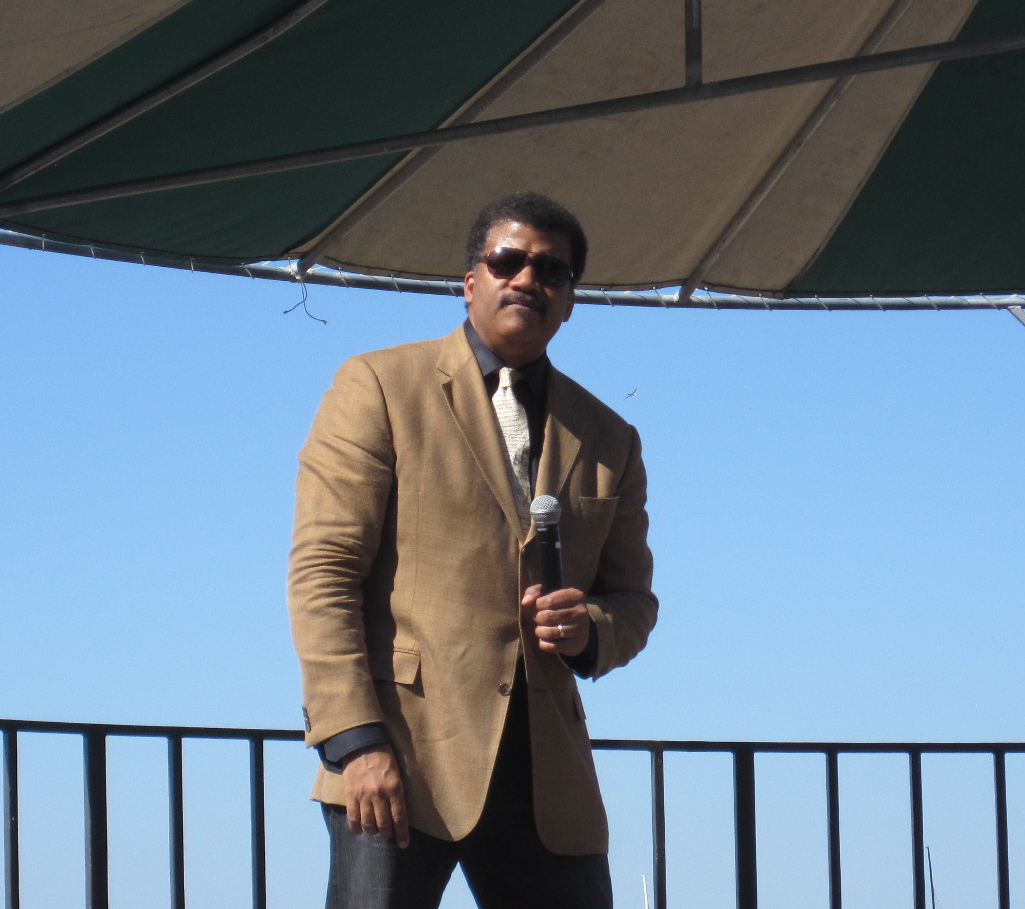
After going through the history of the space program, Tyson started talking about the economy and why investment in space and science overall can help. People in general seem to have this impression that NASA gets a big chunk of the federal budget, but Tyson pointed out that if NASA actually got what people think it gets NASA would be rolling in it. The perception of the budget is pretty skewed. What I love most about Tyson is that he says things that just make sense. When talking about innovation he said that the way you keep jobs in the U.S. is by making things that no one else can. Well, duh. But then where is the big push to invest in innovation? We aren't doing ourselves any favors by not trying to invent. Perhaps my favorite line from his talk (which was full of quotable one-liners) was "If the dinosaurs had had a space program, you can bet they would have used it" basically about how to save us from ourselves.

Seeing a speaker like Neil deGrasse Tyson meant a lot to me. He lived up to the hype. I was impressed with the caliber of his ideas in addition to his stage presence and the great dynamic he developed with the audience. All of us sitting there, the sea of students strewn on the concrete in front of the stage, get to walk away from this year at UW-Madison having heard from a man who is without a doubt one of the biggest bad asses in science communication. I mean he paused at one point to tweet his own talk (@neiltyson) that takes some cojones and an awesome sense of humor. It was a great experience, and I can't wait to read Tyson's new book!

Also you should watch this because well, it is astounding:

Monday, July 11, 2011

Godspeed, Atlantis

via Geekosystem
I wanted to make sure to post some pictures and the video of the final launch of the space shuttle Atlantis. This past Friday July 8th at 11:29 am the last American space shuttle to travel to space left on its final journey. The 135 shuttle flight, and the 33rd for Atlantis, the flight marks the end of the entire space shuttle program. The YouTube video can't be embedded, but you can watch it here on the NASA YouTube channel and here are also a few pictures to highlight some of the great moments:

Getting ready! via Geekosystem
Firing up the engines! via Geekosystem
Liftoff! via Geekosystem
There she goes! via Geekosystem
Atlantis, flight STS-135, is commanded by Chris Ferguson, and will take fellow crewmates Pilot Doug Hurley, and Mission Specialists Sandy Magnus and Rex Walheim to the International Space Station. The launch took place at NASA's Kennedy Space Center. The 12-day mission will bring the Raffaello multi-purpose logistics module with more than 8,000 pounds of supplies and space parts to the space station to sustain it after the last space shuttle is retired.

On a personal level I find it amazing that the space shuttle program is over. I have never known a time in my life where Americans were not traveling to space. When I was little the first thing I ever wanted to be was an astronaut. It shocks me that astronaut isn't really a job anymore, at least not at NASA. Sure, there are other countries that will still be traveling to and from the International Space Station (Russia and China) but its just not the same as having an American space program. 

I appreciate the need to focus on new frontiers in space and wanting to move in a new direction, but I am pretty disappointed that there isn't a successor to the space shuttle program already lined up. I think its dangerous to give up our hold on space travel and research to focus on programs and initiatives that don't really exist yet. I'm worried that space exploration will become another casualty of a lack of vision, appreciation, and long term planning that seems to plague this country. Especially if the proposed budget for NASA which I wrote about over on Geekosystem ($2 billion in cuts!) is any indication of what the future holds. 

I wish that I had appreciated the space shuttle program more while it was running. How many shuttle launches have you watched? How much do you know about what the shuttle program accomplished? Honestly, I can hang my head in shame and say not many and not much. Its too late to lament what we've already lost, but I think we can see the end of the space shuttle program as a warning to take more interest in some of the amazing research programs the government funds. If we don't show the government that these things matter to us, we're going to lose them all. 

So Godspeed Atlantis, the launch was amazing and as an American I am so proud of the shuttle program  and our astronauts. I've felt for a long time that there are simply no heroes anymore, but for the six-year-old in me that wanted nothing more than to go to outer space I think our astronauts are the real deal.


Tuesday, December 14, 2010

Leaving the Solar System

There was an interesting story today in the BBC about the NASA space probe Voyager 1, and how it is nearing the edge of our solar system. Voyager 1 has traveled the farthest of all the vessel to be launched from Earth. It will be the first space probe to ever leave our solar system.

Launch of Voyager 1.
Source: Wikimedia Commons. 
What I found so interesting about the Voyager 1 probe is that it was launched in 1977, making it 33 years old. This machine has been collecting and transmitting data about space back to Earth for longer than I have been alive. I think that is pretty amazing, and it is a testament to engineering that NASA's scientists were able to make a machine that could still function properly after all this time.

Voyager 1 and its partner Voyager 2 were initially launched to survey the outermost planets in our solar system: Jupiter, Saturn, Uranus, and Neptune. Voyager 2 is nowhere near the edge of the solar system however, because after it was finished with the outer planets in 1989 it was put on a much slower course than Voyager 1.

According to researchers, Voyager 1 should cross the threshold outside of our solar system sometime in the next five years, so this story will definitely be coming up in the news again in the future.

Wednesday, December 8, 2010

Diamond Planet

New research using NASA's Spritzer Space Telescope has shown that planets in our galaxy may be more carbon based than others meaning that the ground would be made of diamonds instead of sand (rocks, dirt, essentially what our soil is made of.)
The new planetary discovery, Wasp12b, is a gas giant like Jupiter, and wouldn't have the water necessary to sustain life. But, just the idea that a planet made of diamonds could exist is definitely fun. Its strange how something that is such a hot commodity on Earth could be so ordinary somewhere else with just a few changes in chemical composition.

I couldn't do a post about diamonds and not include a little Marilyn Monroe, after all Diamonds Are A Girl's Best Friend:

Monday, October 25, 2010

Water on the Moon

Source: Wikimedia Commons.
Since I was a little kid, I've loved space. The whole idea that there are other worlds surrounding us has always fascinated me. But, alas I am not so good with chemistry, physics, and math so studying space was never really within my academic dreams. I still got to daydream though, and who doesn't love imaging what it would be like to live in space?

Well, NASA scientists are one step closer to colonizing the Moon, according to research reported earlier this month. Researchers performed experiments that used rockets to collide with lunar craters to loosen rocks and dust that could be evaluated for their chemical compounds, and found a significant amount of water in the craters.

Access to water would be necessary to sustain a colony anywhere, so the discovery that there might be water resources on the moon that could be used by people is a step in the right direction toward people branching out and living on the moon.

The BBC article by Johnathan Amos: Moon's water is useful resource, says NASA

Sunday, October 24, 2010

Commercialized Space Flight

NASA Space Shuttle Atlantis. Source: Wikimedia Commons
People have been taking about commercializing space flight for years, but according to the BBC article "Runway opens at worlds first spaceport" Sir Richard Branson (the Virgin group) is going to make it a reality within the next few weeks.

Of course you don't get to spend any real time in space, they are marketing a three hour journey where you get launched into space and then come back. If you have the money though it would be pretty cool to be able to say that you've been to space. At least 300 people at $200,000 each think so, and have already signed up for the flight.