Thursday, January 13, 2011

The Plant That Took Over America

Sphagnum subnitens. Source: Wikimedia Commons.
It grows, it spreads, it takes over North America... its peat moss. Now I know that peat moss isn't exactly the most exciting of topics, but the article Single peat moss plant 'conquered America' stood out to me for a few reasons.

I have written a lot about genome sequencing and genetics, and this research sequenced the genome of the peat moss Sphagnum subnitens, and found that all the samples they collected were genetically identical. This means that there is a common ancestor for the peat moss that spread prolifically throughout North America. 

The research was conducted by teams from Ramapo College in New Jersey (another reason why this article caught my attention,) Binghamton University in New York, and Duke University in North Carolina.  The different types of peat moss vary in color and are found in distinct locations, which makes the 100% genetic match all the more amazing. 

The moss species reproduces sexually, but a single plant can make both the necessary sperm and eggs so its offspring are genetically identical, without being asexually reproduced clones.

Animal Tagging Ethics

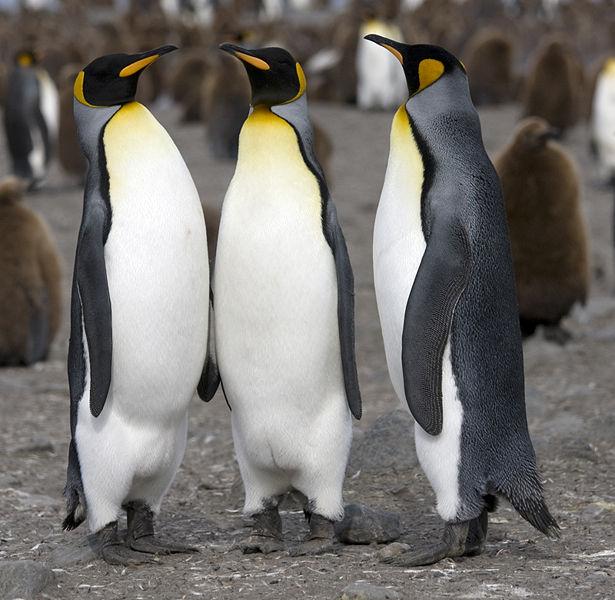
King Penguins. Source: Wikimedia Commons.
New research published in the journal Nature says that the most popular way for tagging penguins for scientific analysis - putting a band around a flipper - may be detrimental to the penguins' reproduction and survival. This brings up the ethical issue of whether or not the practice of tagging with a band should be continued.

Researchers from the University of Strasbourg and the French Centre National de la Recherche Scientifique (CNRS) wanted to clear up debate about whether or not the tags, which have been in use for over a decade, have an effect on the penguins detrimental or otherwise.

The study, in king penguins, showed that penguins tagged with the bands had 40% fewer chicks than un-banded penguins. Banded penguins also lived shorter lives. The finding is likely to be controversial because it draws into question the validity of past research done using the bands.

The research also has ties to climate change because many penguin species are already threatened due to changes in their environment. In addition to the typical ethics of whether or not its right to do something that could be harmful in any way, tagging with the bands could also be seen as unethical for stressing an already challenged populations.

Wednesday, January 12, 2011

Universal Flu Vaccine

H1N1 Virus. Source: Wikimedia Commons.
A new study in the Journal of Experimental Medicine reports that people who fight off the swine flu (H1N1) develop antibodies that can help them fight off other flu infections as well. This finding could be used to create a universal flu vaccine that would eliminate the need for a yearly flu shot against that year's most likely problematic strains.

Five antibodies isolated from patients that had successfully fended off swine flu appeared different than those antibodies created to fight more typical flu strains. Those antibodies have proven able to fight off even virulent flu strains like the "spanish flu" from 1918 and bird flu (H5N1).

The important thing to remember with a breakthrough like this is that even thought the results are promising, it takes a long time to get from the basic research stage to human trails and widespread availability as a treatment. So even if this works, don't expect a universal vaccine anytime soon. It is likely to be five years or more before doctors can even think about saying goodbye to yearly flu shots.

Monday, January 10, 2011

Poison That Packs A Punch

My holiday break is starting to wind down (as evidenced by the Christmas tree that has made its way out to the front lawn to await collection) but thing are just as busy as ever. I spent a large chunk of today applying to internships for the summer, and pitching one of my articles from last semester. We'll see if I get responses, but for now I feel productive having at least sent out so many emails.

After such a productive morning I treated myself to an afternoon of reading and was able to finish my advisor Deb Blum's latest book Poisoner's Handbook. I said back in the fall that I wanted to read her book, and I was lucky enough to win a signed copy at the end of the semester event for UW's online literary magazine Corkboard (which features the work of some very talented student writers, so you should check it out.)

Poisoner's Handbook tells the story of New York City's first chief medical examiner, Charles Norris and famous toxicologist Alexander Gettler. The book is a work of literary journalism that chronicles the rise of toxicology and forensic medicine in the 1920's and 1930's covering prohibition and the great depression. I thought the book was well written, and I'm not just saying that because Blum has say over my grades. She does a great job of making chemistry approachable, and I hate chemistry so that is actually a big compliment.

The book is organized with each chapter representing a different poision, with some paragraphs on Norris, Gettler, and the science of toxicology and some paragraphs describing a murder case showing the effects of each chapter's poison. If anything I would say that because some of the people described in some of the murder cases reappear in other chapters, it can be hard to remember who is who. But even so, that did't dampen my enjoyment of the book. The structure was easy to follow, and even in moments where I had to think back to remember a character I was never really lost.

Knowing Deb Blum personally there were points where I could actually hear her in my head reading aloud the words on each page. In our literary journalism class she would read us experts from each of the authors we studied so I've gotten used to the cadence of her speech. I found it pretty interesting that I could see the same rhythm in her writing, and it made me wonder if I write the way I talk.

Poisoner's Handbook is the fifth book I've read since coming home, and hopefully I'll be able to finish one more before heading back next week. I am running out of space on my bookshelves at home, but I still love seeing my little library. It makes me feel oddly accomplished.