Showing posts with label Science History. Show all posts

Saturday, July 28, 2012

Vacation Adventure: The La Brea Tar Pits

During my nearly three week blogging hiatus (caused mostly by the fact that I moved and started a new job) I also took my first trip to California. It was recommended to me on twitter that I check out the Natural History Museum of Los Angeles, which when I looked it up led me to the Page Museum at the La Brea Tar Pits. The Page Museum houses one of the world's largest collections of late Pleistocene fossils and is the only constantly active urban Ice Age excavation site in the world. Mammoths? Yes, please. So my family (also intrigued, though not as much as I was) agreed to make a visit to the La Brea Tar Pits during our trip, and boy was it a tar pit. But it was also so much more. 

Yup, that would be tar. Credit: Erin Podolak
The La Brea Tar Pits are located in Los Angeles. The area of Hancock Park (where the lake pit pictured above and the museum are located) has crude oil underneath it. The oil seeps up along fault lines and when it reaches the surface it forms pools and becomes asphalt. The tar has been seeping up for tens of thousands of years, and at times would be deep and thick enough to trap animals. Water, dust, or leaves would obscure the tar, and when animals would wander into the pit they would become trapped. The struggle to get out of the tar would attract predators, which could also get trapped in the tar and eventually die. The remains of these animals would then be enveloped in the tar, which does a remarkable job at preserving the bones.

While the tar pits were known about as early as the 1780's it wasn't until 1875 when William Denton, a professor at Wellesley College, visited the Hancock family's property at Rancho La Brea and identified a piece of bone as a tooth from a saber-toothed cat that the remains from the tar pits were identified as belonging to a species that wasn't just a typical modern animal. Despite this it wasn't until 1901 when geologist William W. Orcutt, who was checking out prospects for oil production on the land, noticed a piece of armored hide from an extinct ground sloth in the asphalt that the real process of uncovering the La Brea area's hidden fossils began.

A display of 400 dire wolf skulls at the Page museum
Credit: Erin Podolak
Excavations of the area have been ongoing since the initial 1913-1915 project began. The 23 acre Hancock estate was officially turned over by the family to Los Angeles County for scientific exploration. The density and richness of the La Brea area is really remarkable. Several examples of prehistoric species have been uncovered at the La Brea Tar Pits including mammoths, mastadons, dire wolves, short-faced bears, ground sloths and saber-toothed cats. I think it can be easy to forget that until only 11,000 years ago North America had some tremendous large mammals that were all driven extinct. My favorites are definitely the short-faced bear and the ground sloth. By comparison, dinosaurs last roamed the Earth 65 million years ago. The last ice age dates to 0.3 million years ago. The Pleistocene, when many of the La Brea animals would have lived dates from 40,000 to 11,000 years ago. Several of the bones have been dated using Carbon-14 radiometric dating, which showed some of the oldest remains to be 46, 800 years old. 

Despite all of the fossils that have been recovered from the area, the tar pits still continue to give up more. According to the Page Museum's website since 1906 more than one million bones have been recovered representing over 231 species of vertebrates in addition to 159 species of plants and 234 invertebrates. An estimate of the size of the Page Museum's collection is at about three million items. Three million. Excavations are still going on today at the La Brea Tar Pits with Project 23, a series of 23 crates of samples from the pits that were uncovered when the neighboring Los Angeles County Museum of Art excavated the area to build an underground parking lot.

You just can't visit the La Brea Tar Pits without riding the
ground sloth. Or at least, that is how I felt.  
What I loved about the La Brea Tar Pits was the ability to ignite a sense of imagination. I thought it was great to try to visualize what the area would have looked like some 40,000 years ago. Trying to imagine an animal like a mastodon just wandering by you as you watch tar bubbling up to the surface of the lake pit definitely peaked my sense of wonder at the world. If you find yourself in the Los Angeles area, I definitely recommend the La Brea Tar Pits as a must see for kids and adults. The museum is fun and informative and the grounds that you can walk around and peer into the pits are definitely interesting to see. Really, who wouldn't want the chance to ride a ground sloth?

Wednesday, June 13, 2012

The Perverted Penguin Paper

I often write about stories or headlines and how it is obvious that the media just couldn't resist. Well, in this instance I couldn't resist. I've been putting off writing a new blog post for various reasons but when I saw the headline, "Depraved sex acts by penguins shocked polar explorer" I knew I had my next post. The story has everything: animals, behavior, history, science, and an obviously irresistible headline.

Science history is an area I have no training in, but it combines two subjects that I've always found interesting. If I'd had more time I probably would have added a history minor to my Bachelor's because I took so many history classes as electives. I obviously have a love for all things science, so add history to that and my interest is definitely peaked. Especially after my history of the scientific book and journal class from last semester.

Adelie penguin. Credit: Stan Shebs
via Wikimedia Commons
The article that caught my attention is about the recent publication of notes and papers written by George Murray Levick regarding the sexual behavior of adelie penguins (Pygoscelis adeliae). Levick was a biologist and medical officer of the Terra Nova Expedition to the South Pole 1910-1912. The Terra Nova Expedition is infamous because several members (not Levick) attempted to be the first group to reach the South Pole. By the time they arrived, a Norwegian team led by Roald Amundsen had beaten them to it and on their return journey the members of the Terra Nova Expedition who had attempted the trip all perished.

Prior to and following his involvement with the ill-fated Terra Nova Expedition, Levick was a leading expert in the study of penguins and was the first person to observe penguins for an entire breeding season. His observations of their sexual behavior were apparently quite scandalous. So much so that when Levick wrote a paper about his observations including what he dubbed "sexual coercion" "depravity" and even necrophilia (male penguins having sex with dead females), that portion of the paper was not included in the official publication. Instead, 100 copies were discreetly distributed to select scientists.

Douglas Russell, curator of eggs and nests at the British Natural History Museum, discovered one of the only two remaining copies of Levick's lascivious penguin paper in the museum's files. Russell and colleagues have published their interpretation of Levick's findings in the journal Polar Record. The original paper and handwritten notes by Levick are now on display at the museum.

According to Russell, scientists in the early 1900's didn't understand the penguins' behavior but now scientists have a better base of knowledge for understanding Levick's original observations. For example, what he described as necrophilia isn't actually necrophilia the way the behavior is understood in humans. When it occurs in penguins, scientists now believe male penguins are confusing dead females with live females due to specific body positioning. In the BBC's article about it, Russell says he thinks researchers in Levick's time often looked at penguins like little people, but their behavior needs to be understood in terms of their own species. They are birds, and need to be observed in that context.

I really like this story for several reasons. Of course, I enjoy being able to title this post with an inappropriate alliteration, but I also really love the historical significance. Levick is an interesting scientist for his ground breaking work with penguins, but also for his participation in the Terra Nova Expedition. I love that this is a story about animal behavior, an area that I've written about and been interested in for some time. I also love that this is about penguins, because who doesn't like penguins? So there you have it, all the components of an irresistible blog post.

Monday, June 4, 2012

Finding Amelia Earhart's Plane: New TIGHAR Expedition

The Internet doesn't think very highly of Amelia Earhart. As a girl I was fortunate enough to do school projects on some great female role models. One that stands out in my memory was Amelia Earhart. Learning about great women helped form my conviction at an early age that women have as much to offer the world as men. I loved Amelia Earhart for what she represented to me: defiance, adventure and mystery. Reading this article in the Telegraph, and checking out the comments where she is called a "dumb woman" and "foolish" made me pause. The commenters also slam the effort to find out what happened to her based on the Telegraph's claim that the expedition is "backed" by the U.S. Navy. 

The article is about The International Group for Historic Aircraft Recovery's (TIGHAR) planned trip this July to try to located the remains of Earhart's Lockheed Electra aircraft. I've written before about TIGHAR and their efforts to find enough evidence to conclude that Earhart landed, and later died on the island of Nikumaroro in the Republic of Kiribati. According to some of the commenters finding out what happened to Earhart isn't worth the effort. Some say because she was an idiot flying when she did and some say it isn't worth it because of the money. Many of the commenters are up in arms that the Navy is "backing" the project on the grounds that the economy is still down and this is a stupid thing to spend money on. 

I was surprised to see the Telegraph headline, "US Navy prepares mission to solve riddle of Amelia Earhart's death" knowing that the TIGHAR expedition to find the plane was planned for this summer. When you read the Telegraph's article, you can see that the expedition they are talking about is the one by TIGHAR. Now, TIGHAR is funded by contributions not federal money. It is not getting your tax payer dollars. I know this, because I googled. Having written about them before I went back to the TIGHAR website to see what they had to say about their alleged joint mission with the Navy. 

This is what I found (pulled directly from their website) bolding is mine:
"As with previous TIGHAR expeditions, funding for this search is being raise entirely through contributions from private citizens, foundations and corporations. Lockheed Marting is leaidng a growing family of corporate sponsors. TIGHAR's long-time sponsor FedEx is aboard with a major contribution in shipping services, and we are proud to announce that in addition to helping sponsor our expedition, Discovery Channel is producing a television special to air later this year documenting the search.  
Underwater operations will be conducted for TIGHAR by Phoenix International, the U.S. Navy's primary contractor for deep ocean search and recovery. We'll sail from Honolulu July 2nd - the 75th anniversary of the Earhart disappearance. TIGHAR is deeply appreciative of the expressions of support voiced by Secretary Clinton, Secretary LaHood, Secretary Lambourne, Assistant Secretary Campbell, and Dr. Ballard."
The U.S. Navy is not paying for TIGHAR's expedition to try to locate Earhart's plane. They say it themselves on their website, they are funded by private and corporate donations. The announcement by the State Department that they support and are backing the expedition is just that - a statement. The terms "support" and "backing" automatically make one think money. I thought money when I read the Telegraph's headline and article. But in this case "support" and "backing" comes in the form of verbal acknowledgement and a few nice press pictures, not oodles of taxpayer dollars. It also probably helped get Phoenix International onboard to do the actual mapping/search, but they are going to be paid out of TIGHAR's coffers.

Still, Earhart is just a stupid woman got herself killed by taking off on a poorly planned trip right? Even if all those commenters up in arms about their money going to something they think is silly have been mislead by the article there are still those that think Earhart doesn't matter. I like the idea of going out there to try to figure out what really happened to Earhart because there is historic and social value to knowing how her story ended. She is an important figure in aviation history, women's history, and United States history. She mattered. She mattered in her time, and for girls like me who read about her in books and start to believe that they can truly do anything with their life she still matters. 

It isn't a secret that I find Earhart inspiring. I've posted about her twice before this. Seeing her called dumb and foolish for trying to fly around the world annoys me. She took a risk, and she paid for it with her life. You mean to tell me no man has ever done that? She knew she could fail in her journey. She took off anyway. Was it a good choice? No. She made a bad choice, but the key word there is choice. She was a female aviator in the 1930's who took her own life in her hands, she made choices. I admire Earhart because she lived her life in a way that gave her the ability to choose for herself. So I do support TIGHAR's effort to find the plane and some conclusive evidence about what happened to her. I'm glad the State Department supports it too. I'm also glad that the funding is private, I think that is how it should be. Shame on the Telegraph for printing something so misleading. 

If all I had to do was go to the TIGHAR website to find out how the State Department and Navy were involved in the expedition, there is no reason the Telegraph shouldn't have done the same. Rather than making this a story about Earhart, the Telegraph article made this a story about government spending and waste. That isn't the story at all. I would much rather have seen some real coverage of Earhart - the good and the bad - leading up to the 75th anniversary of her disappearance. 

Thursday, May 17, 2012

Lessons From Neil deGrasse Tyson

On the day I attended the last college class of my higher education experience, I also attended a talk given by astrophysicist Neil deGrasse Tyson. For me, it was my commencement. I've made the decision not to walk at graduation for a number of reasons chief among them that none of my colleagues are walking and it didn't make sense to me to do it alone. So I won't be getting the cap, gown, prominent speaker send off typical for most people who complete a Master's degree. Still, the University of Wisconsin-Madison gave me a great parting gift. The opportunity to sit at my favorite place on campus surrounded by other students on a gorgeous day and listen to a person whom I have admired for years talk about the future is the best goodbye I could have asked for.

Neil deGrasse Tyson is an astrophysicist (please don't ask me to explain astrophysics further than saying it is physics in space) at the American Museum of Natural History but he is also an author, speaker, host, and even a meme. You might have seen him on the Colbert Report or the Daily Show throwing down some truth and clarity. He is eloquent, funny and honestly one of the people I admire most in the field of science communication. He pulls no punches, while still being extremely passionate about space and all the other STEM (science, technology, engineering, and mathematics) fields.

The talk, which took place 5/10/12 on the Terrace here at UW-Madison, started with Tyson talking about the role science plays (or lack thereof) in our culture. He used the example of money, by asking us which scientists appear on U.S. currency. The answer is none. You can make the argument that Benjamin Franklin was a scientist, but his experiments are not what is highlighted on the $100 bill. He is there for his political achievements. This is just an example of the way as a culture we have not placed a strong emphasis on science.

Tyson then went into talking about the history of the U.S. interest in space exploration. He said that historically there are three reasons why people invest a lot of money in a risky exploration: fear of death, promise of economic return, and praise for royalty and deities. If you look at the U.S. push to get to the moon we were acting under #1 fear of death. Our investment in NASA and the space program had everything to do with the Russians and the Cold War. When the communist threat was gone, the space program started to decline. I think Tyson really drove home this point when he said that if the Chinese decided to declare that they were building military bases on Mars the U.S. would get ourselves on Mars within 10 months. We could if we wanted to, we just don't invest in the necessary programs. We need to feel threatened before we actually do anything, how very American of us.

After going through the history of the space program, Tyson started talking about the economy and why investment in space and science overall can help. People in general seem to have this impression that NASA gets a big chunk of the federal budget, but Tyson pointed out that if NASA actually got what people think it gets NASA would be rolling in it. The perception of the budget is pretty skewed. What I love most about Tyson is that he says things that just make sense. When talking about innovation he said that the way you keep jobs in the U.S. is by making things that no one else can. Well, duh. But then where is the big push to invest in innovation? We aren't doing ourselves any favors by not trying to invent. Perhaps my favorite line from his talk (which was full of quotable one-liners) was "If the dinosaurs had had a space program, you can bet they would have used it" basically about how to save us from ourselves.

Seeing a speaker like Neil deGrasse Tyson meant a lot to me. He lived up to the hype. I was impressed with the caliber of his ideas in addition to his stage presence and the great dynamic he developed with the audience. All of us sitting there, the sea of students strewn on the concrete in front of the stage, get to walk away from this year at UW-Madison having heard from a man who is without a doubt one of the biggest bad asses in science communication. I mean he paused at one point to tweet his own talk (@neiltyson) that takes some cojones and an awesome sense of humor. It was a great experience, and I can't wait to read Tyson's new book!

Also you should watch this because well, it is astounding:

Thursday, March 1, 2012

History of the Scientific Book and Journal

Every Monday afternoon, I go to Narnia. At least that is what it feels like to me. In the post I wrote about the book Blood Work, I mentioned that I am taking a class on the history of the scientific book and journal. I've been asked to elaborate on what we do in that class, which I'm happy to do because it is easily one of my favorite courses I've taken.

The course is offered through the History of Science Department here at UW, and is taught by Robin Rider. We meet in the special collections department of UW's Memorial Library. The reason I equate going to class with going to Narnia is because special collections is accessible by a single elevator, separate from all the others, which is the only one that goes all the way up to the ninth floor. Special collections is gorgeous. When you step off the elevator into this magical land it is all glass and dark wood with soothing low lights and the books, oh the books. For me, short of my own library complete with floor to ceiling bookshelves and a ladder to ride around and find things, special collections is as good as a library is going to get.

via University Communications
What I love most about the class is that it gives me the ability to just completely nerd out for a few hours. There is something I love about holding a book in my hands, I felt it when reading Science Ink a few weeks ago, and I feel it every time I get to handle the class materials. A few weeks ago in class we got to see the library's copy of Andreas Vesalius' 1543 De Humani Corporis Fabrica (On the structure of the human body). I was pretty awe struck, to actually get to see for yourself something from so long ago that was so important in its time was amazing to me.

Two years ago I was an intern at a science journal (BioTechniques) and was lucky enough to be exposed to a lot of the editorial decision making and publication processes as the journal was put together each month. I found getting to handle copies of the Philosophical Transactions (including the first one published!) of the Royal Society and the Memoirs of France's Academy of Sciences particularly interesting as early examples of journal writing. There is just something about getting to turn those yellowed pages myself that thrills me. Nerd alert, I know.

There are a lot of issues from back then, when the conventions of printing and publishing were just coming to be, that are still worth debate today. For instance in preparing for my next class meeting I was just reading about the issue of author anonymity in writing. Now, for the most part I believe that putting your name on something is a good way to evoke trust in what you say - at least you are owning it. However, at the same time I see why there are people out there (some wonderful science bloggers come to mind) who choose to operate under a pseudonym. Safety in the wake of backlash against what you say (extreme or not) was an issue back then (ahem, Galileo) and it remains one today. Writers - no matter what you choose to write, scientific paper, blog post, etc. - open themselves up to criticism which can and does escalate. I find it interesting that so many centuries later, claiming individual ownership over words would still be an unsettled issue.

I enjoy that in my last semester of grad school I am being exposed to so many wonderful pieces of science history, but also to the ideas, procedures, and processes that go into creating a printed work. We got to tour the Silver Buckle Press, which is located in Memorial Library, during class. I had no idea UW had a collection of old printing presses, let alone that they were set up in a working print shop on campus. I even got to print something myself, which believe me was fun. For me, this class is about incorporating new experiences and ideas with things I already knew or had at least heard of in some way. It is like taking a step deeper into the world of the written word, and so far it has been amazing.

I'm taking this class as an elective, and I would recommend it. The downsides are that the readings sometimes take more effort than a few clicks of the mouse to get to, and special collections is cold sometimes. Otherwise the professor is enthusiastic, the course work isn't particularly heavy, and I've learned a lot.

Saturday, February 25, 2012

Book Review: Blood Work

I recently made a trip home, and decided to grab a book from the UW Bookstore to keep me company on my flight. I felt like it was time to read another piece of narrative non-fiction, so I picked up Blood Work by Holly Tucker. The book is about the first human experiments conducted on blood transfusion. I have no background of any kind in studying blood transfusion or in studying European and medical history in the time period of the 1660's. However, I was drawn to the book because I was intrigued by the way it was marketed on the jacket as, "a tale of medicine and murder in the scientific revolution." It seemed like something that would keep me awake on my nighttime flight.

As it turned out, Blood Work was a perfect compliment to the material we are covering in my History of the Scientific Book and Journal class this semester. Of all the classes that I've ever taken, this is one of my favorites. It is in the special collections of the UW Library and we get to handle the real texts, but I digress. We were just looking at early copies of the Philosophical Transactions, the publication of London's Royal Society and the Memoirs of France's Academy of Sciences. These two publications, and their respective societies are an important part of Tucker's book. Publication is the means of spreading information, and getting into the journal of a national science organization was the premier means of getting attention for your work - critical for the early blood experiments.

Blood Work tells the story of Jean-Baptiste Denis one of the first medical doctors to experiment with animal to human blood transfusions. At the time, blood transfusion was extremely controversial because medical knowledge was conflicted about what exactly blood did in the body, what it was made of, and how it connected to the essence or soul of a person. There were fears that transfusing animal blood into humans would create horrible hybrid human animals. This resulted in two strong camps, those in favor of blood transfusion who believed it had the power to cure a variety of problems including mental illness, and those of the traditional way of thinking who wanted nothing to do with blood transfusions. Despite the controversy there were researchers engaging in these experiments anyway, and Denis was one of Paris' most famous (or infamous depending on how you see it.)

What I liked most about this book was that while well researched and factual about science and the time period, the narrative was extremely strong. This is a vivid story with great characters struggling not just to further medical research but also to make a name for themselves, with their reputations and all that goes along with them at stake. You will learn a lot of history, not just medically, but of the time period. You certainly won't be bored by details. The narrative is well crafted and engaging.

I loved seeing the work that went into researching this story. You can tell Tucker really did her homework to try to unravel the mystery of what happened to the patient in Denis' most famous animal to human blood transfusion. Without giving too much away, I'll say that the patient dies and it calls into question the safety of blood transfusions. The incident serves as proof for those medical doctors opposed to blood transfusion research to have the experiments, and thus Denis, shut down. However, there is a question about whether the transfusion killed the patient, or more sinister means were employed in a conspiracy to tank the research. The incident resulted in blood transfusion itself going on trial.

This book was enthralling. I was reading in a busy environment, and had to put it down several times out of the necessity of moving around and traveling. I was able to keep coming back to it though, because my interest was peaked enough to want to find out what happened in the end. This story has mystery, a conspiracy, and science. I was certainly hooked. This isn't really a fun read, not the kind of thing you'd want to take to the gym or the beach, but it is definitely interesting and worth the time if you'd like to learn something new about research in the 17th century, and be entertained while doing it.

One of the things that left me thinking after I'd put the book down was Tucker's epilogue where she compares the blood transfusion experiments with modern day stem cell research. Blood transfusion is now a standard medical procedure (though not interspecies, we've learned that human to human blood transfusions are the way to go because the body can reject the blood of another species). However, it was greatly feared when it was first proposed, and that fear set the research back years. I thought the corollary to how stem cell research has been perceived by certain groups was a strong one, and it certainly got me thinking about how research that might seem "extreme" these days may be viewed in the future. Overall, I'm glad I read it.

Monday, November 21, 2011

Captive Breeding and Mummification?

As I've mentioned before I am taking a class this semester about the extinction of species. One of the topics we recently covered (and I recently got a crash course in for the midterm) is captive breeding. Captive breeding is a conservation strategy in which animals are captured and held in a protected area, where they are then bred to another specific animal of their species to optimize the production and survival of their offspring. I just assumed that this was a more recent (meaning within the last century) trend in conservation efforts, but then I saw this BBC article about the effects of sacrifice and mummification on Egyptian species, and realized how wrong I was.

Mummified monkey in Cairo. Source:
Wikimedia Commons.
The ancient Egyptians would often mummify animals to be included in a person's tomb as a sacrifice to follow the dead into the afterlife to provide company and serve as an offering to the gods. However, according to the article by Jane O'Brien, the Egyptians had favorite species that they chose to mummify. They sacrificed these animals so much that they put these species in danger of extinction. Thus, to keep up with demand captive breeding was needed to keep the number of available animals high.

Experts, like Selima Ikram a professor of Egyptology at the American University in Cairo who was quoted in the BBC article, believe that at least one bird species (the Sacred Ibis) was so popular for mummification that it was driven close to extinction. Other animals that were popular for mummification were dogs, cats, hawks, falcons, and baboons, although Ikram was quoted saying:
"Its easier to say which animals the Egyptians didn't mummify. There are no mummified pigs as far as we know, no mummified hippos, and I think thats about it - because almost every other creature at some time or another has been mummified." 
According to the article, when the animals most sought after for mummification started to become rare in the wild, breeding programs were launched by temples (the animals were often seen as sacred or representations of the gods) and the nearby villages. Evidence of these programs shows them in place as early as 3,000BC with the height of captive breeding at 650BC-200AD.

I liked this article because it provided a little bit of context about why animals would have been slaughtered for sacrifice in such great numbers. If you just look at the fact that so many animals were killed, it seems like the Egyptians were being selfish, putting human desires (not even needs) above all these animals. However, you have to look at their religion, and how they viewed the animals. Ikram says that the Egyptians would have viewed sacrificing the animals as a great honor for the animals, because they were so revered. The focus was on life, and continuing the animals' existence in the afterlife, not on death or killing them. I think this bit of context is a really important part of the story and I'm glad it was included in the BBC article. Captive breeding by the Ancient Egyptians... who knew?
***
Just want to note that the BBC piece was a plug for the Smithsonian Institution's National Museum of Natural History's new exhibit of mummified animals. Haven't seen it and can't endorse it, but it looks like it might be pretty cool to check out if you are in the DC area. 

Friday, September 30, 2011

Book Review: Devices & Desires

I thought it was amusing that the first condoms in history were made from the casings of animal intestines. Yet, when I tried to share this information I was met with the typical head shaking, and entreaties to find different reading material characteristic of me sharing new found knowledge with friends. In my post about Mary Roach's Stiff, I mentioned how my friends don't find the interesting tidbits I gleaned about cadavers to be proper cocktail conversation. Well, the same goes for all the interesting tidbits I gathered from reading Andrea Tone's Devices & Desires.

I am taking a history of science course this semester on the history of women and health in America. As a grad student in an undergrad class, I have to complete extra work to make the requirements. One of the extra assignments was to read and discuss Devices & Desires: A History of Contraceptives in America with the other grad student and the professor. I am a fish out of water in this class, having no background whatsoever in women's issues (aside from, you know being a woman myself), and while I was aware of the timeline for the development of contraceptives there was a lot about them I didn't know. Thus my excited, and apparently gross, interest in what I learned from the book.

Devices & Desires can be broken roughly into three sections: condoms, the pill, and intrauterine devices (IUDs). The section about condoms was by far the most interesting and engaging. My professor (Karen Walloch) suggested that perhaps this was the section that Tone researched for her thesis, and while that is just speculation it does seem to be the part of the book that the writer was most invested in. Fun fact: when scientists first developed a way for rubber to be shaped and thus used as condoms, companies that today we associate with tires (Firestone, BF Goodrich, Goodyear) all dabbled in condoms.

My favorite chapters in the book dealt with the military's stance on condoms during WWI, and how they eventually had to cave and endorse them because the health care cost of venereal diseases was through the roof. The book had a few different advertisements and propaganda posters for servicemen urging them to stay away from women that I found highly amusing. Apparently just say no, and taking the moral high ground are no match for a dame in a dress.

After the condom chapters the book tackles the birth control pill. While I found the information interesting, I felt like it fell a little flat. For such a controversial topic, that had such a drastic impact on women's lives I think Tone could have infused the writing with more personality. It just wasn't as colorful as the condom chapters. As a science writer, I did really appreciate the description of the research process that went into making synthetic hormones and how these were tested. The initial testing on the pill was done in Puerto Rico, because the researchers/financiers thought there wouldn't be as much controversy and public push back. They were very wrong. But, if you aren't interested in the scientific process, I feel like these chapters might drag on for you as a reader.

From the pill, the book moves on to the IUD. Tone focuses on a particular IUD, the Dalkon Shield. I was really shocked by this part of the book. Shocked, and really kind of outraged that I hadn't heard about this health scandal. In the 1970's the Dalkon Shield was the cause of more than 200,000 lawsuits due to a high percentage of severe injury among its users. The design of this IUD made it a ticking time bomb that women were sticking into their bodies. Infections (and subsequent Pelvic Inflammatory Disease) caused by the materials used in the device caused severe damage to women's reproductive systems (even sterility), the device could also perforate the uterine wall, and women who did get pregnant while wearing the device often had children born with severe birth defects.

Lawsuits against the A.H. Robbins Corporation (who marketed the Dalkon Shield) won millions of dollars in damages for women and families that had been affected. The real tragedy in the Dalkon Shield scandal is that the company was well aware of the device's problems. Internal documents and studies proved that the company knew the device was dangerous, and marketed it anyway. As a result of the scandal, in 1976 the Medical Device Amendments to the Food, Drug, and Cosmetic Act mandated the U.S. Food and Drug Administration for the first to time test and approve of medical devices.

It is important to note that the major flaw in the Dalkon Shield: a porous, multifilament string that was basically a highway for bacteria straight up into the uterus, isn't a part of IUDs currently on the market. I know several people who use IUDs and am relieved to know that the devices have been improved since they first debuted on the contraceptive scene. However, the Dalkon Shield story really made me stop and think about the human cost of not only contraceptive devices, but all new medical breakthroughs.

As much as I learned from and was moved by reading the chapters about IUDs in Tone's book, these chapters left me wanting more. I felt like the book ended very abruptly, and that there was still a lot that could have been said about the topic. My professor pointed out that when you are writing a book like this, you have to choose a place to stop, otherwise you could just go on and on. I understand that, but I think the book could have ended more smoothly.

Overall, I thought Devices & Desires was a great read and I learned a lot from it that I hadn't been aware of otherwise. The book was a little disjointed in parts, and you have to be invested in seeing it through (and apparently not squeamish) but if you come from an uninformed background like mine, I can almost guarantee you'll learn something new.

Sunday, July 24, 2011

Explaining All Of Human History Shouldn't Be Hard, Right?

So I'm about 15 years late hopping on the band wagon for this one, but I recently read Jared Diamond's Guns Germs and Steel: The Fates of Human Societies. The book was originally published in 1997 but at that time I was only 9 years old, and most certainly wasn't ready to ponder the question of why some societies were able to dominate others in the course of human history. But, for my birthday this year my good friend Cassi gave me a copy of Diamond's book because she'd heard good things about it from her Dad and she thought it was something I would like. For the most part, she was right.

Overall I liked the book a lot, it brought up some really interesting ideas about human history that I had never considered before. But I struggled a little to get through the whole book, reading with the amount of concentration it deserved. Most of my difficulty stemmed from the way I read, which is particularly disjointed and distracted on the train. There are some parts of Diamond's book that are just really dry, but I don't think the book would work without these dry patches because explanations are necessary. There are also plenty of anecdotes and more narrative portions to keep the book moving forward.

Guns, Germs, and Steel seeks to answer Yali's question, and comes back to this concept repeatedly throughout the book. Yali is a member of a native tribe in New Guinea where Diamond did field work. He asks Diamond, "Why is it that you white people developed so much cargo and brought it to New Guinea, but we black people had so little cargo of our own?" There is no single easy answer to this question. It takes Diamond 19 chapters and 465 pages to explain it and even then as he says that only gives him an average of one page per continent per 150 years to compress 13,000 years of history.

So then how do you go about answering a question like Yali's? When a lot of the context, detail, and narrative is stripped away the main reason Diamond gives is that there are biogeographical differences between the areas of the world where societies developed and where they didn't. These biogeographical differences include things like the availability of domesticable plants and animals, variations in climate, and differences in the navigability of different continents. Additionally, Diamond talks a lot about intellectual growth through the spread of information, in addition to the spread of more dangerous components of human interaction like weapons and disease.

When you put the context, detail and narrative back in, there are a few points that Diamond makes that hit me pretty hard. One point is the way that contact between developing societies was critical to helping them succeed. For me when I think about societies that are just starting, I assume that the longer they have to develop on their own the better off they would be. But the exact opposite is true. Societies need to develop alongside each other.

Areas like Eurasia that were way better suited for an exchange of information and ideas are the areas that advanced fastest. On the other side, areas like southern Africa and Mesoamerica struggled because their climates (desert and jungles) weren't suitable for traveling. People weren't able to connect and because of this not only could they not learn from each other (agriculture, language, etc.) they also didn't develop important immunities to disease. I feel like I've always assumed that a disproportionate amount of resources like food and animals was the reason why some cultures flourished over others. In part the lack of resources in some areas was certainly a factor, but I was really surprised by the idea that the continent itself could have a huge impact.

I think my favorite chapters by far dealt with the Aztec, Inca, and Maya societies and how they were able to be conquered. I think I've always been quick to write their fall off as being caused by disease and the superior weapons of the Spanish. I had never really thought about how the isolation of each of these societies also led them to be more trusting - and that this more than anything else is what led to their downfall.

Another point Diamond makes that I found really interesting is that there are so many factors that need to align properly for a society to succeed, and it often comes down to which societies have the best balance. I always think of competition between countries as a bad thing, but Diamond shows that competition is exactly what gave Europe an edge over China when it came to dominating the colonial world. A unified China struggled with implementing new technology because if the rulers didn't approve then changes didn't happen. Whereas in Europe with so many small societies competing with each other if one group rejected an idea, another was sure to adopt it and help it spread. But competition also has obvious drawbacks like fighting and wars that cause widespread casualties. It really comes down to having the right amount of competition and conflict, that magical balance that allows a nation to surge ahead.

These are just a few of the ideas that Diamond discusses. I found this book to be very informative, so much so that it was almost difficult to digest sometimes. There is also a ton of background and set up so that the reader will be able to understand his analysis. One place where for me this was tedious was animal domestication. I already knew a lot about animal domestication from my class with animal behaviorist Patricia McConnell last semester, but if I didn't I am certainly well informed for having read Diamond's book.

There is a lot of information to be had here, and if you have the stamina and the attention span you could learn a significant amount from Diamond's book. I do recommend it because it definitely got me thinking about history in a new way. I also think its important to point out that the book stands the test of time. My version has a 2003 update with a new afterward and an additional chapter about Japan, but even so the original text has held up well. I never felt like I was reading something out of date.

So to sum it up, its a good read, but you have to really want to read it. This isn't a beach book or something to read on the train (like I did) it deserves your full attention, and if you can't give it I'm not sure you'll make it through. 

Tuesday, July 19, 2011

Polar Bears Have The Luck Of The Irish

I recently learned that I share a trait with my absolute favorite animal, the polar bear, in that we can both trace our ancestry back to Ireland. For people who follow this blog, or have at least looked back through the archives a bit, you'll see that I find it impossible to pass up a good polar bear story. I've written about animal healthcare, mysterious death, and the polar bear's status (or lack thereof) as an endangered species. So it should come as no surprise that I can't pass up the opportunity to talk about this new research that shows an ancient Irish connection to modern day polar bears.

via Wikimedia Commons
A team of researchers led by Beth Shapiro of Penn State University and Daniel Bradley of Trinity College (Dublin) has identified a common ancestor of polar bears (Ursus maritimus) and brown bears  (Ursus arctos) that lived in Ireland before the peak of the last ice age some 20,000 to 50,000 years ago. The researchers concluded that all modern day polar bears can trace their lineage back to this ancient female brown bear. The specific lineage of the brown bear that shared their mitochondrial DNA with polar bears went extinct around 9,000 years ago, but the research still shows that the modern species are related.

Despite significant differences between polar bears and brown bears (size, coloring, fur type, tooth shape, swimming ability vs. climbing ability, etc.) scientists have suspected for some time that the species have closely connected histories. The polar bear is known to have mitochondrial DNA (the part of the genome contributed by the mother) that traces back to the brown bear. But how modern polar bears acquired this brown bear DNA was a bit of a mystery.

via Wikimedia Commons
The two species are known to interbreed, and have been studied in captivity in addition to being spotted in the wild. An example of a polar bear/brown bear hybrid, jokingly nicknamed grolar bear or pizzly, was found in the wild Canada in 2006. But, even with the knowledge that the two species can co-mingle scientists were still perplexed about the history of these different species. The long standing theory about how polar bears evolved from brown bears had their history traced to the ABC Islands (the Alaskan Islands of Admiralty, Baranof, and Chichagof) around 14,000 years ago. But the bears' genomes tell us a different story.

The research team led by Shapiro and Bradley found that the hybridization of polar bears occurred much earlier than would have been possible on the ABC Islands through a genetic analysis of the bears. The study analyzed 242 samples from polar bear and brown bear mitochondrial DNA spanning 120,000 years and several different geographical regions. The researchers found that the fixation of the mitochondrial genome in polar bears likely occurred closer to 50,000 years ago in the area of present-day Ireland.

According to Shapiro, in addition to genetic evidence, the interconnected history of the polar bear and brown bear is also supported by climate events. One example of this is the British-Irish ice sheet, which reached its maximum range around 20,000 years ago. At this time parts of Ireland would have been difficult to inhabit, pushing bears from the warmer areas toward ice shelves and land exposed by lower sea levels. This would have brought the bears into close contact with their northern neighbors, showing how the animals that became two different bear species could have started out in the similar location, sharing their genes.

The polar bear is currently considered a threatened species, and future conservation efforts may be aided by this new understanding of its genetic history and its ability to hybridize with the brown bear. The research is described in the paper, "Ancient Hybridization and an Irish Origin for the Modern Polar Bear Matriline" in the journal Current Biology.

Monday, July 11, 2011

Godspeed, Atlantis

via Geekosystem
I wanted to make sure to post some pictures and the video of the final launch of the space shuttle Atlantis. This past Friday July 8th at 11:29 am the last American space shuttle to travel to space left on its final journey. The 135 shuttle flight, and the 33rd for Atlantis, the flight marks the end of the entire space shuttle program. The YouTube video can't be embedded, but you can watch it here on the NASA YouTube channel and here are also a few pictures to highlight some of the great moments:

Getting ready! via Geekosystem
Firing up the engines! via Geekosystem
Liftoff! via Geekosystem
There she goes! via Geekosystem
Atlantis, flight STS-135, is commanded by Chris Ferguson, and will take fellow crewmates Pilot Doug Hurley, and Mission Specialists Sandy Magnus and Rex Walheim to the International Space Station. The launch took place at NASA's Kennedy Space Center. The 12-day mission will bring the Raffaello multi-purpose logistics module with more than 8,000 pounds of supplies and space parts to the space station to sustain it after the last space shuttle is retired.

On a personal level I find it amazing that the space shuttle program is over. I have never known a time in my life where Americans were not traveling to space. When I was little the first thing I ever wanted to be was an astronaut. It shocks me that astronaut isn't really a job anymore, at least not at NASA. Sure, there are other countries that will still be traveling to and from the International Space Station (Russia and China) but its just not the same as having an American space program. 

I appreciate the need to focus on new frontiers in space and wanting to move in a new direction, but I am pretty disappointed that there isn't a successor to the space shuttle program already lined up. I think its dangerous to give up our hold on space travel and research to focus on programs and initiatives that don't really exist yet. I'm worried that space exploration will become another casualty of a lack of vision, appreciation, and long term planning that seems to plague this country. Especially if the proposed budget for NASA which I wrote about over on Geekosystem ($2 billion in cuts!) is any indication of what the future holds. 

I wish that I had appreciated the space shuttle program more while it was running. How many shuttle launches have you watched? How much do you know about what the shuttle program accomplished? Honestly, I can hang my head in shame and say not many and not much. Its too late to lament what we've already lost, but I think we can see the end of the space shuttle program as a warning to take more interest in some of the amazing research programs the government funds. If we don't show the government that these things matter to us, we're going to lose them all. 

So Godspeed Atlantis, the launch was amazing and as an American I am so proud of the shuttle program  and our astronauts. I've felt for a long time that there are simply no heroes anymore, but for the six-year-old in me that wanted nothing more than to go to outer space I think our astronauts are the real deal.


Thursday, June 16, 2011

The Arabian Oryx's Comeback Story

We see so many stories proclaiming the final nail in the coffin of so many species around the world (and indeed, species extinction is a serious issue) but today there is actually some good news about the Arabian oryx, which was previously considered extinct in the wild. Good news needs to be talked about more, so inspired by this post from New Scientist I wanted to share the Arabian oryx's story.

Arabian Oryx, via Wikimedia Commons
Around 1972 the last wild Arabian oryx (Oryx leucoryx) was killed, most likely in Oman. While the species was extinct in the wild there were still several in captivity, particularly at the Phoenix Zoo, which received four wild Arabian oryx in 1963 as a part of a conservation effort called Operation Oryx.

After the species went extinct in the wild, individuals from the zoo’s breeding program were brought together with individuals from royal collections in Abu Dhabi, Qatar, and Saudi Arabia to make a last “world herd.”  A breeding program began and in the early 1980’s the first individuals were reintroduced into the wild in Saudi Arabia, Israel, the United Arab Emirates and Jordan. 

The Arabian oryx has since flourished, reaching a wild population of more than 1000 individuals, and is continuing to increase. This had led to the Arabian oryx officially being moved from endangered to vulnerable on the IUCN Red List. A 2008 assessment showed that the Arabian oryx had recovered enough to no longer qualify as even an endangered species.

The IUCN Species Program produces, maintains and manages the IUCN Red List, and implements worldwide species conversation projects. The Species Program is headquartered in Switzerland and is designed to determine the relative risk of a species facing extinction. The Red List is used to keep track of and bring attention to the plants and animals that directly risk global extinction. 

IUCN Red List categoriesUnder IUCN Red List Guidelines a species can only move to a lower category if none of the criteria for the higher category have been met for five years or more. To be considered endangered there must be 250 or fewer mature individuals of a species, so the Arabian oryx, which is doing well at over 1000, will be listed as Vulnerable starting this year.

The Arabian oryx is native to the Arabian Peninsula, and doesn’t have many natural predators; humans drove the animals to extinction from hunting. In addition to the 1000 in the wild there are another 6,000-7,000 individuals alive in captivity around the world, many within the Arabian region.

Interestingly, the population that was re-introduced to Oman (where the last wild Arabian oryx were killed before it went extinct in the wild) has been struggling. The Oman population was hurt through illegal live capture for private sale, and has been rendered ineffective because only males remain.  Most new populations are in secure areas that are relatively safe from poaching, but animals that wander outside protected sites have no guarantee of safety. 
Future release locations for animals bred through captivity will be determined by the potential effects of drought and overgrazing, which have reduced available areas where populations could thrive. 

Now that I'm spending my days perusing the internet (so much more than ever before!) I've seen a lot of strange, strange, and I mean STRANGE things. In addition there is also so much negative news from hackers to politicians to criminal cases and everything in between that I feel like little glimmers of good news, particularly about successful conservation efforts should to be recognized. It doesn't make the bad news easier to swallow, but it still makes things seem brighter. 

Wednesday, May 25, 2011

The Allure of a Good Ghost Story

When I was six my parents, brother and I moved to a cute brick house just the rights size for us. It hadn't been lived in for a few years because the elderly couple that had owned it passed away in hospice, while a caretaker maintained the house. When my parents bought it, the house was a blast from the past. Pale yellow bathroom fixtures, peeling linoleum floors, blue eagle kitchen wallpaper, mustard yellow velour couch, seafoam green paint in the living room. Because the home's previous owners had passed away, some strange/awesome/old features (like that couch) got tossed in with the sale.

Moving meant that for the first time in our lives my brother (slightly older) and I would each get our own room. My room was going to be pink, and it was going to be Aladdin and Jasmine themed and I was thrilled. That is - I was thrilled until the kids down the street told me the "truth" my parents were hiding. The house, specifically MY room, was haunted.

Obviously, the house was haunted. Old people lived there, and they DIED. Of course they came back to haunt the house. Specifically, I was told, they haunted my closet. The proof of this haunting was the fact that sticks and leaves stuffed in the mail slot of the house while it was unoccupied waiting for sale MYSTERIOUSLY disappeared. No one lived there, so then who moved them, right? Clearly the answer was ghosts, and what ghost wouldn't like being trapped in a closet?

Nothing like a creepy staircase
Source: Wikimedia Commons
At the wise old age of six I was skeptical, but didn't understand enough about real estate to know that prior to showing a house any real estate agent would remove random detritus shoved through the mail slot by pesky neighborhood kids. When I reported my news of the haunting to my Mom she informed me that there was no such thing as ghosts. But then why did I always check to make sure the closet was shut firmly before going to bed? Why did I RUN up the basement stairs every time I had to go down there? Why did the old furniture and fixtures seem like the perfect backdrop for a ghost story?

I've now lived in that house for over 15 years, and I've never had a close encounter of the ghostly kind. But the ghost story told to me back then about my haunted closet is to my memory my first real encounter with the supernatural. Flash forward to my college years, and my interest in ghost stories was again peaked by the Discovery Channel show A Haunting. My roommate and I started watching A Haunting every weekday because it was on at 3pm, when we didn't have class. We quickly became enthralled, coming to such conclusions as "it always happens to the Catholics" and "blessing your new home is asking for it."

I've never felt any otherwordly connection to spirits or the like, but I find it hard to dismiss the possibility of life after death all together. Just because there is no proof, or at least no definitive proof, doesn't mean hinky things don't happen, right? So with this background and frame of mind, I was all too excited to read "Ghost Hunters: William James and the Search for Scientific Proof of Life After Death" by Deborah Blum.

Those who read my blog regularly know that I'm studying at the University of Wisconsin-Madison, and I have Deb Blum as a professor. No, she doesn't require or even ask us to read her books. Yes, I've already gotten my grades for the semester, and no, I'm not sucking up by reading through her books. I'm curious about the work of the person I'm learning from. I've given my thoughts on Poisoner's Handbook, and Love At Goon Park & The Monkey Wars in previous posts - and just want to share a few reflections from Ghost Hunters.

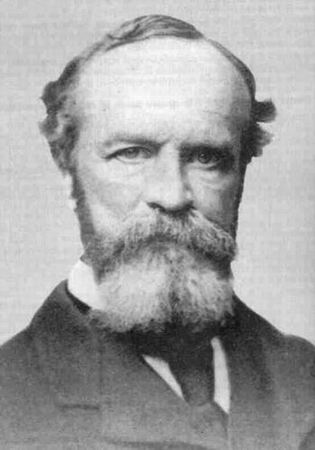
The book chronicles the rise of the American and British Societies for Psychical Research, through several characters, most dominantly Edmund Gurney, Henry Sidgwick, Frederic Myers, Richard Hodgson, and William James (brother of the writer Henry James - The Aspern Papers, the Turn of the Screw, etc.) and of course the famous medium Leonora Piper. These people set out in the 1880's to try to prove the existence of life after death. Obviously, since this is something that has yet to be determined 130 years later, they did not succeed. But what they did do was devote their lives to trying to make psychical research a legitimate science.

William James
Source: Wikimedia Commons
The researchers studied phenomenon like slate writing, floating furniture, the appearance of specters (white floating blobs, etc.) strange lights, blowing curtains, and the claims by mediums that they could speak to the dearly departed. The majority of what the researchers did was expose fraud. But there was one medium, that the majority of psychical researchers believed in - Mrs. Piper. This medium stood out for the fact that she didn't charge for sittings, and wasn't making money off of her "abilities." One of the most interesting experiments with the medium described in Blum's book is the "cross-correspondence" study.

The term telepathy was developed by the first psychical researchers to describe the ability to communicate thoughts mentally. They set up an experiment to see if the spirits of people who had died would be able to take a thought conveyed by a medium, and transmit it to a different medium. Mrs. Piper was sent to London, the medium Margaret Verrall was in Cambridge, and Alice Kipling Fleming (sister of Rudyard Kipling) was in India. Myers, Gurney, and Hodgson were by this time deceased, so the remaining psychical researchers set out to communicate with their old colleagues.

Lines of poems and words in Greek and Latin (languages unknown to the mediums) were reportedly conveyed between the mediums in their different locations. But is that evidence of life after death, or telepathy, or spiritual communication? I don't know. At the time (in the early 1900's) it wasn't enough proof. The argument was that the psychical researchers wanted so badly to prove that they could communicate with their departed colleagues and show that the mediums were real, that their desires colored the study and skewed results. Perhaps making something out of nothing. Perhaps so dedicated and well-intentioned that they did summon up spiritual communication.

What I like most about Ghost Hunters is that Blum never decides whether any of the experiments did or did not prove the existence of life after death. I don't see how she could. I think that even today, while there are so many "events" that can't be explained away as tricks, smoke and mirrors, or active imaginations, there is still nothing definitive to show that spirits exist. I don't think there ever will be. I think that this is a case where, "for those who believe no proof is necessary, for those who don't believe no proof is possible" (Stuart Chase.)

While I am a firm believer that nothing haunts my closet, I can't explain "the unexplained" and I won't try. But thats not what Ghost Hunters is about anyway. It is a fascinating history of the work of several researchers (and friends) trying to make sense of the things that go bump in the night using the scientific experimental standards they believed in most. Ultimately I think it comes down to the belief that eventually science can explain everything - and having to accept that it hasn't, and maybe never will.

For me, the drama in the book is not will the psychical experiments be successful but rather, will they ever be accepted? Ghost Hunters tackles the issue of exclusivity in the scientific community and examines where scientists draw their line in the sand as far as what should and should not count as science. The definition of science is the intellectual and practical activity encompassing the systematic study of the structure and behavior of the physical and natural world. Do ghost hunters count? Should they count? Who gets to decide what is science and what is a waste of time?

Of the books that I have read by Blum, I enjoyed Ghost Hunters the most. I love science, but sometimes even the best science books can get confusing and having to work to maintain clarity, I lose interest. The sign of a great writer is to be able to take a subject and weave together the stories of all the different people involved in developing that subject, without getting the reader lost. I was never confused while reading Ghost Hunters about who was who or what was going on. I was enthralled from start to finish - not because I love a good ghost story, but because I love the richness of science history, and the real stories of these rogue researchers.

Thursday, May 19, 2011

What Makes A Planet A Planet?

I grew up believing that there were nine planets: Mercury, Venus, Earth, Mars, Jupiter, Saturn, Uranus, Neptune and Pluto. Then, in 2006 my understanding of the universe was shaken when poor little Pluto was stripped of its classification and labelled just another object in the Kuiper Belt, an area that extends from the orbit of Neptune and contains thousands of icy "objects" with the same consistency as Pluto.

The decision that Pluto was not a planet came in 2006 based on the 2005 discovery of Eris, an object larger than Pluto, in the Kuiper Belt. Pluto and Eris are both considered "dwarf planets." According to the International Astronomical Union for an object to be a planet it must meet three criteria:
  1. It needs to orbit around the sun (or if part of a different solar system than ours, it needs to orbit around another star)
  2. It needs to have enough gravity to pull itself into a spherical shape
  3. It must be the dominant gravitational body in its orbit (thus any smaller body in its orbit is either consumed or flung away by the object's gravitational pull - being smaller than Eris, Pluto clearly doesn't qualify)
Pluto by the Hubble Space Telescope via Wikimedia Commons
But why digress on a five-year old story about a former planet's rejection? Well, because the issue of what makes something a planet seems like it could again be coming into question. This week the BBC  ran the article "Free-floating planets found with no star in sight" talking about the new discovery of objects in space that are seemingly un-connected to a star. The BBC article is referencing the research "Bound and unbound planets abound" featured in Nature, and as we learned from the Pluto experience, criteria #1 for being classified as a planet is that the object in question needs to orbit a star.

So then what is going on with the new discovery of at least 10 objects the size of Jupiter that don't orbit a star? The research suggests that objects like this might be so common, they actually outnumber stars 2:1. While the BBC's article states that researcher are cautious to completely flip our understanding of the universe based on a single study - if true, it would completely flip our understanding of the universe.

The definition of a planet is firmly grounded in the three criteria listed above, so these new objects don't fit the bill because #1 - orbiting a star is violated. But then, what are they? The answer to that is a little complicated. The BBC's article doesn't explain it. So, since I have zero background in astronomy, I did some digging and found Phil Plait's blog Bad Astronomy for Discover.

According to Plait's post called "The galaxy may swarm with billions of wandering planets," the objects talked about in the Nature study either formed like stars or they formed like planets in solar systems (like our own) and got tossed out. Plait favors the latter, saying they are most likely rejects from other solar systems.

He explains that massive planets often form along the outside of a solar system, and then migrate inward toward the center star. This could cause other plants in the path of the migrating planet to undergo changes in their orbit, or even get flung out the solar system completely. It is these planets that get flung out of their solar system by the movement of larger planets that could be the star-less objects featured in the Nature study. The evidence in favor of this theory is the prevalence of large plants that orbit very close to their stars.

So most likely - the objects in question ARE planets, they formed like planets, in a solar system that orbited a star. But, somewhere along the way they got tossed out of their solar system, and thus became free-floating planets.

I'll be interested to see if there is any kind of distinction as far as name or classification that these rogue planets are given, that identifies that they are different than your typical planet. Lord knows losing Pluto was bad enough, I'm not sure what I'll do if there is another planetary shake up. Its rough seeing things you learned when you were six get turned on their head. But, it is also incredibly cool how much new information the universe still has to give up. I really love the idea that there could be so many free-floating planets out there waiting to be discovered.

Friday, April 29, 2011

Wisconsin's Place in the History of Animal Research

I decided to apply to graduate school at the University of Wisconsin-Madison at the recommendation of my undergraduate advisor. I honestly wasn't thrilled with the idea of coming to the midwest. I had never really considered what the cheese state was like before I applied - as a strictly east coast girl it was so far removed from everything in my life I couldn't even imagine living here. But, when the college admission chips fell where they did, it was obvious to me that UW Madison was the clear first choice for grad school.

That being said, when I arrived in Wisconsin nearly nine months ago, I knew very little about the history of the University I was attending. I knew that UW-Madison was home to an amazing amount of scientific research, but I had no idea how rich the tradition of scientific inquiry really was. I quickly became aware of the Wisconsin National Primate Research Center (WNPRC) and notorious, and immensely important, psychology researcher Harry Harlow.

Those who follow this blog regularly know that I have written a lot of posts this semester inspired by my zoology class on human and animal behavior. It is this class that really got me motivated to learn more about animal research, and in particular UW-Madison's role in animal research. That brought me to two books, both written by Deborah Blum a professor in the journalism school here at UW.

In 1992 Blum won the Pulitzer Prize for a series of articles on the ethical dilemmas posed by primate research. She turned this into the 1994 book The Monkey Wars. I was enthralled by the history of primate research in the United States, and am ashamed to admit how little I knew prior to reading the book. The story of Edward Taub, the Silver Spring Monkeys (named after the site of the lab in Maryland,) and the rise of PETA in 1981 had me riveted. The condensed version of that story is that PETA founder Alex Pacheco volunteered undercover in the lab of Taub, who was conducting neurological experiments on monkeys (severing the nerves to control a limb and then coaxing nerve regeneration.) The monkeys were held in filthy conditions - but there was no legal standard for research animal care at the time. Pacheco took photographs (some admittedly staged) and went to the police to have Taub arrested (which he was - for animal cruelty.)

The majority of events described in the book take place long before I was even born, and I suppose thats why I felt so removed from them. I didn't realize I was taking the idea that animals have rights for granted until I learned about the history of animal research in this country. I knew that people are cruel to animals, but I was blissfully oblivious to the cruelty that was standard in research labs in the 1950's, 1960's, and 1970's. After finishing Monkey Wars, my blissful respect for science felt somewhat dingy - and I needed more information.

The book I picked up next, to explore the history of animal research and in particular its role in Wisconsin, was Blum's 2002 biography of Harry Harlow, Love at Goon Park. I don't think I had ever heard the name Harry Harlow before moving to Wisconsin - yet his work is something that I reap the benefits of in my daily life. Harlow is both famous and infamous for his "mother love" and "pit of despair" (a catchy term for depression) studies. His research used rhesus macaque babies to show that children need love and social interaction - particularly touch - to function and develop normally, and that being isolated can be the cause of a complete psychological breakdown.

The reason Harlow is so controversial is that the way he studied depression and isolation from one's mother was to psychologically "break" baby monkeys. These were horrible studies. The monkeys were taken away from their mothers and given a variety of fake substitutes to see which the babies would cling to most (warm, cloth, animated mother was the winning surrogate but cold metal mother caused psychological damage to her babies.) For the depression studies the babies were put in isolation cages for 3-6 months at a time, with no interaction at all. The monkeys suffered tremendously. The concept of love as a necessity needed to be proven, to move parental nurturing into the mainstream. But the question remains if it needed to be proven in that way.

Considering that I was surprised by just how awful the United States history of animal research is, you can imagine how shocking I found it that studies were needed to prove that mothers should hug their children. But then again, as Blum so poignantly points out, the scientific standard at the time was to isolate children for health reasons (limit the spread of bacteria & disease.) What seems so obvious to me - that animals should be well taken care of, that children should be hugged - were really revolutions within the scientific community. Looking back we can say how ridiculous it is that such assertions needed to be scientifically proven, but then again think about where we might be if these ideas had never been generally accepted.

This semester has really driven home for me just how much I owe to animals. The idea that my mom would have been condemned as a bad mother for hugging me when I cried were it not for Harry Harlow and his baby rhesus macaques makes me very appreciative of the role of animals in research. I remember so vividly crying on my Mom's shoulder at maybe 4 or 5 years old. I remember the silky salmon colored blouse she was wearing. I remember staining it mercilessly with my tears, but I don't know why I was crying. I do know that all I wanted was to be held, and have my hair stroked and be comforted. I can't imagine my parents keeping me at arm's length.

We owe a lot to the animals who started the social movement that changed the way people parented, and the researcher who brought it all to light for making society take notice; and I had no idea about either before coming to Wisconsin. While I do my fair share of whining about being in the cheese state, my experiences here have opened my mind to a lot of new concepts - particularly with regard to the role animals play in society and how we as humans should regard them.